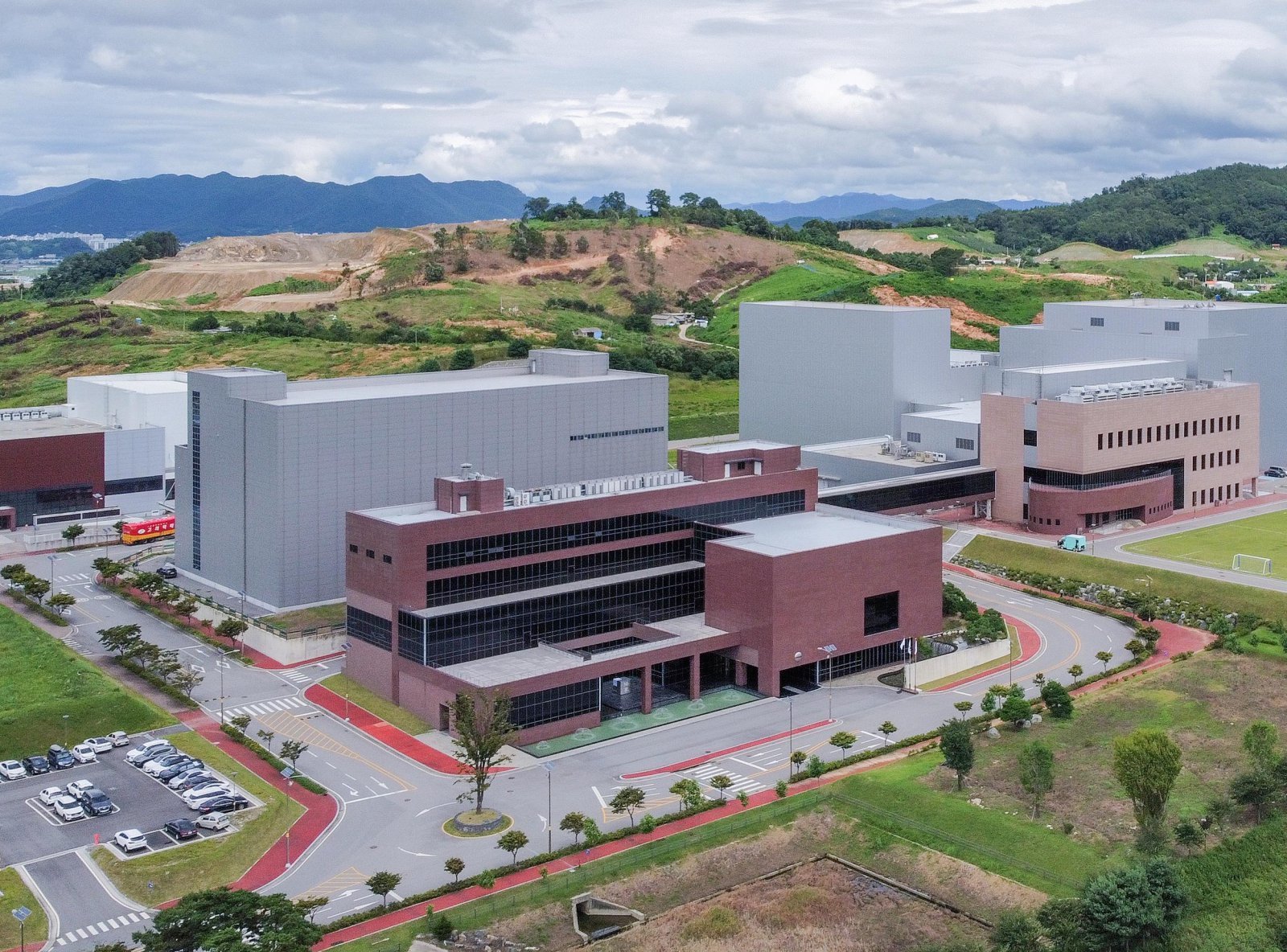
Boryung Corp.’s production complex, the Yesan Campus. Provided by Boryung
‘Acquire the original drug businesses of global big pharma. Use the resulting production capacity to expand the contract development and manufacturing organization (CDMO) business, and then accelerate the overseas expansion of proprietary products by leveraging the established global distribution network.’
This is the global growth strategy drawn up by Boryung. The three pillars of acquiring original branded businesses, expanding CDMO operations, and exporting proprietary products are not strategies built in the short term. Based on its experience in acquiring domestic businesses, the company internalized production capabilities and, on that foundation, has entered into a phase of step-by-step evolution toward expanding global direct sales and CDMO operations. Each of these three business pillars, which have grown individually, is now starting to converge into a single strategic framework. Boryung describes this as a virtuous cycle of “acquisition–internalization–expansion.” The goal of achieving KRW 200 billion in global business revenue by 2030 represents the end point of this strategic advancement.
Boryung’s strategy is clear. It acquires and directly operates proven original branded businesses, then leverages the manufacturing capabilities accumulated in the process to expand its CDMO operations. On top of that, it uses the overseas distribution and regulatory infrastructure secured through acquisitions to accelerate the global rollout of proprietary products such as the “Kanarb family.” While the business areas are different, they are ultimately linked as a single growth engine.
Market conditions are also favorable to this strategy. In the global pharmaceutical industry, stable production and supply capacity are emerging as key factors that determine corporate competitiveness. Amid repeated global shortages of essential medicines, Boryung’s strategy of securing original branded businesses and enhancing supply stability on the back of verified manufacturing capabilities aligns closely with the needs of the global market.
First steps in original brand global businessThe acquisition of original branded businesses involves securing the entire business of original drugs whose patents have expired and directly operating distribution rights, marketing rights, manufacturing rights, distribution rights, and trademark rights. A key feature is that it enables the company to secure already market-validated brands and revenue bases. Starting with “Gemzar,” Boryung has acquired the domestic businesses of “Alimta” and “Zyprexa,” among others, and has built in-house production systems while accumulating related capabilities.
A representative case of extending this strategy to the global market is the cytotoxic anticancer drug “Taxotere.” Boryung secured the global business rights to Taxotere from Sanofi, and related revenue began to be generated from last month. It is regarded as the first case in which a Korean pharmaceutical company has acquired the original anticancer drug business of a global big pharma and directly operates it in overseas markets.
The point of interest goes beyond individual products to the value of the cytotoxic anticancer market itself. Cytotoxic anticancer drugs play an important role in clinical practice, to the extent that they are included in the World Health Organization (WHO) Model List of Essential Medicines, and demand remains steady due to the expansion of combination therapies with immuno-oncology agents and targeted therapies. In advanced markets, they serve as a core component of combination regimens, while in emerging markets they still hold a position as a major first-line treatment option.
By contrast, barriers to entry on the production side are high. Since highly advanced isolation facilities and strict safety management systems are required, the entry of new suppliers is limited. As a result, supply shortages are recurring in the global market, and the value of companies with stable manufacturing capabilities is becoming more prominent. This is why Boryung is putting significant effort into expanding its cytotoxic anticancer portfolio. The strategy is not merely to secure product items but to strengthen its position as a stable supplier in the global market.
Boryung Corp.’s anticancer drug production facilities at the Yesan Campus in Yesan, South Chungcheong Province. Provided by Boryung
World-class manufacturing capabilities as a foundation… further business expansionThe manufacturing capabilities accumulated in the process of transferring the production systems for acquired products to Boryung’s own plants are directly feeding into its competitiveness in the CDMO business.
Boryung recorded its first global CDMO case by supplying the anticancer drug Alimta to Taiwanese pharmaceutical company Lotus. The production base is the Yesan Campus, which has obtained certification under the European Union’s Good Manufacturing Practice (EU-GMP) standards. Subsequently, Boryung signed a supply contract with German company Cheplapharm for the schizophrenia treatment Zyprexa, securing a foundation to supply up to 46 countries, and it has also concluded successive supply contracts with Zuellig Pharma for the Southeast Asian market. The business scope is being expanded from injectables to oral formulations, and from a single country to multiple countries.
In particular, as shortages of essential anticancer drugs persist in the global market, stable production and supply capabilities themselves are being evaluated as key competitive strengths. Boryung is accelerating the expansion of its CDMO business based on the manufacturing experience secured through the operation of original branded businesses.
Another pillar is the overseas expansion of proprietary products. Focusing on the domestically developed antihypertensive new drug Kanarb family, Boryung is actively utilizing the global regulatory and distribution networks obtained through acquisitions of original branded businesses.
Instead of developing new markets entirely from scratch, the strategy is to shorten the time and reduce the costs required for market entry by leveraging existing infrastructure. This also means that the value obtained through the acquisition of original branded businesses is not limited to individual items but also serves as a platform for future exports of proprietary products.
Currently, the Kanarb family is being sold in major overseas markets such as Latin America and Southeast Asia, and additional market expansion is being pursued. “Gelfos,” Boryung’s flagship over-the-counter (OTC) product launched in 1975, is also seeing export growth, mainly in Asian markets including China.
A virtuous cycle of three pillars… leap toward a “global pharmaceutical manufacturing platform”The core of Boryung’s strategy is that the three business pillars do not operate independently. The common foundation that links them is the company’s manufacturing and operational capabilities that can compete in global markets.
The experience of operating original branded businesses such as Taxotere, Gemzar, and Alimta serves as a reliable reference for CDMO clients. The global regulatory approvals and distribution network secured through the Taxotere business are utilized as channels for the overseas expansion of the Kanarb family. The first batch of global CDMO supplies to Taiwan’s Lotus also originated from the same production capabilities.
In essence, acquisitions lead to the strengthening of production capabilities, those production capabilities drive the expansion of CDMO operations and exports, and the expanded global business results then create new business opportunities in turn, forming a virtuous cycle. This is why synergies among the business pillars are bound to increase over time. A Boryung representative said, “Starting with Taxotere, we plan to continuously expand our cytotoxic anticancer portfolio and further advance our production capabilities to broaden our role in the global market.”
Boryung’s ultimate objective is not to remain merely a product-exporting company. Its aim is to evolve into a “global pharmaceutical manufacturing platform” that directly operates original branded businesses, reliably produces essential medicines, and supports the global expansion of proprietary products. The strategy that began with the acquisition of individual products has now evolved into a growth system in which acquisition, production, and export are organically linked, and the target of achieving KRW 200 billion in global business revenue by 2030 lies on that same trajectory.
ⓒ dongA.com. All rights reserved. Reproduction, redistribution, or use for AI training prohibited.
Popular News










 About Dong-A Ilbo