Blue House announces site for Gwangju chip cluster Strengths include construction timeline, transport, and residential conditions Lee: “A national destiny-level race… speed is everything” Yongin fab completion also to be moved up as much as possible
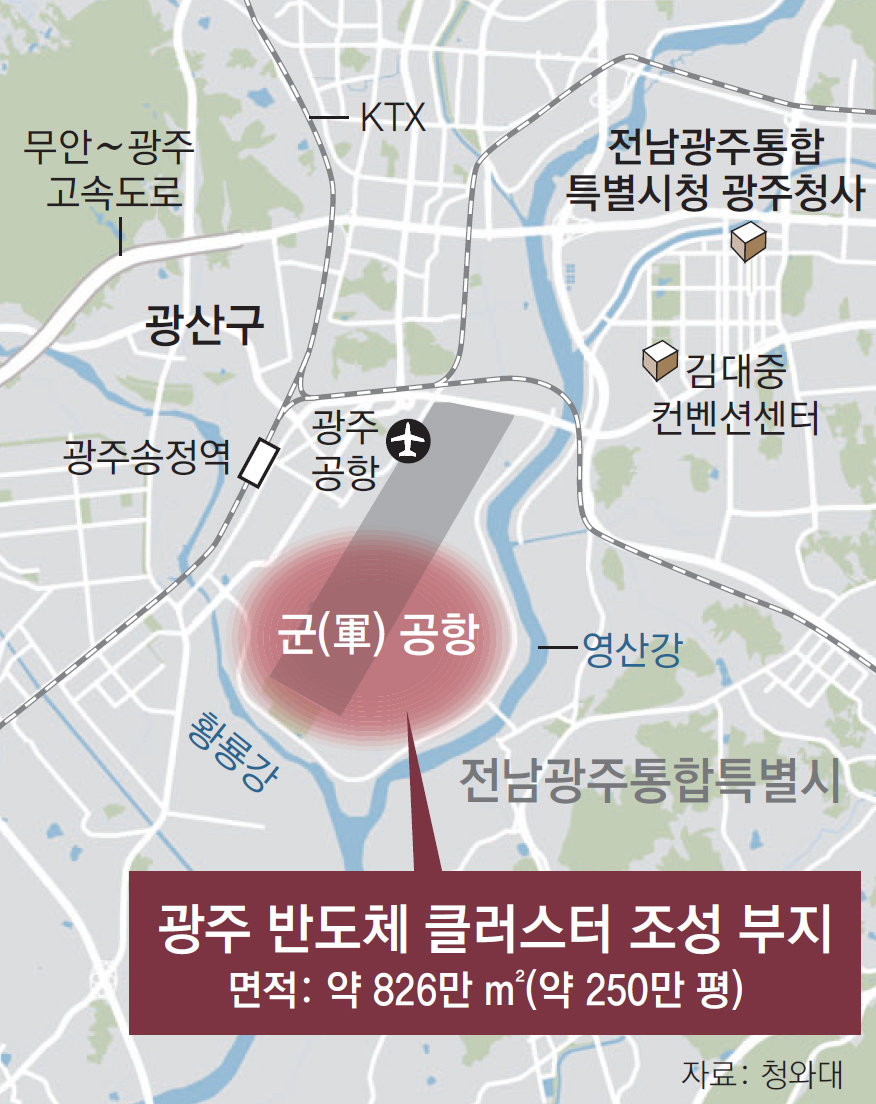
The Office of the President on the 6th announced that Samsung Electronics and SK hynix have decided to build four semiconductor fabrication plants (fabs) for the Honam region on the site of the Gwangju military airport. The presidential office also said it would move up as much as possible the completion schedule for the semiconductor cluster in Yongin, Gyeonggi Province, which is being developed to house 10 fabs. President Lee Jae-myung stated, “A full-scale competition that will determine the fate of the nation is underway,” stressing that “only a race against time matters.”
Presidential Chief of Staff Kang Hoon-sik said in a briefing after the Mega Project Public-Private Joint Review Meeting, chaired by President Lee at the Blue House that day, that “it has been decided to create a Honam semiconductor industrial complex on the military airport site.” Kang said, “The Gwangju military airport area can secure a site of 2.5 million pyeong (about 8.26 million m²), and, as an airport, the land has already been leveled, which will minimize the construction period for site preparation,” adding, “It is adjacent to downtown Gwangju and the KTX station, which is advantageous for securing manpower and residential conditions, and it also offers excellent logistics accessibility connected to roads, airports, and ports.” The government believes that using the military airport base will significantly reduce the time required for land expropriation.
Representatives from Samsung Electronics and SK hynix, who attended the meeting, also stated that the military airport site is the most suitable location for new fabs. As the military airport site is more than twice the size of the alternative candidate Cheomdan 3 District (1.1 million pyeong), it has advantages in terms of expansion potential.
President Lee on the same day emphasized administrative procedures and regulatory easing to accelerate completion not only of the Gwangju project but also of the Yongin semiconductor cluster. On environmental impact assessments, he said, “If it is the same area, is there really a need to conduct another one? If an assessment already exists, it is important to make use of those results,” adding, “Even if a new one is conducted, the period needs to be drastically shortened.” Regarding disputes over so-called “holding out” during land expropriation, he instructed, “Begin the procedures for negotiated acquisition and compulsory expropriation at the same time,” and added, “As long as it is not illegal, it would be preferable to proceed in parallel. If there is a problem with the regulations, it must be resolved through legislation.” Accordingly, the Ministry of Climate, Energy and Environment stated that for the Gwangju semiconductor cluster it would apply the environmental impact assessment results of nearby areas to shorten the period.
Regarding the Yongin semiconductor cluster, Kang further stated, “We will move up the overall schedule as much as possible, from land compensation to the supply of power and industrial water.”
Yun Da-bin;Lee Min-a;Jeon Chae-eun
AI-translated with ChatGPT. Provided as is; original Korean text prevails.
ⓒ dongA.com. All rights reserved. Reproduction, redistribution, or use for AI training prohibited.










 About Dong-A Ilbo