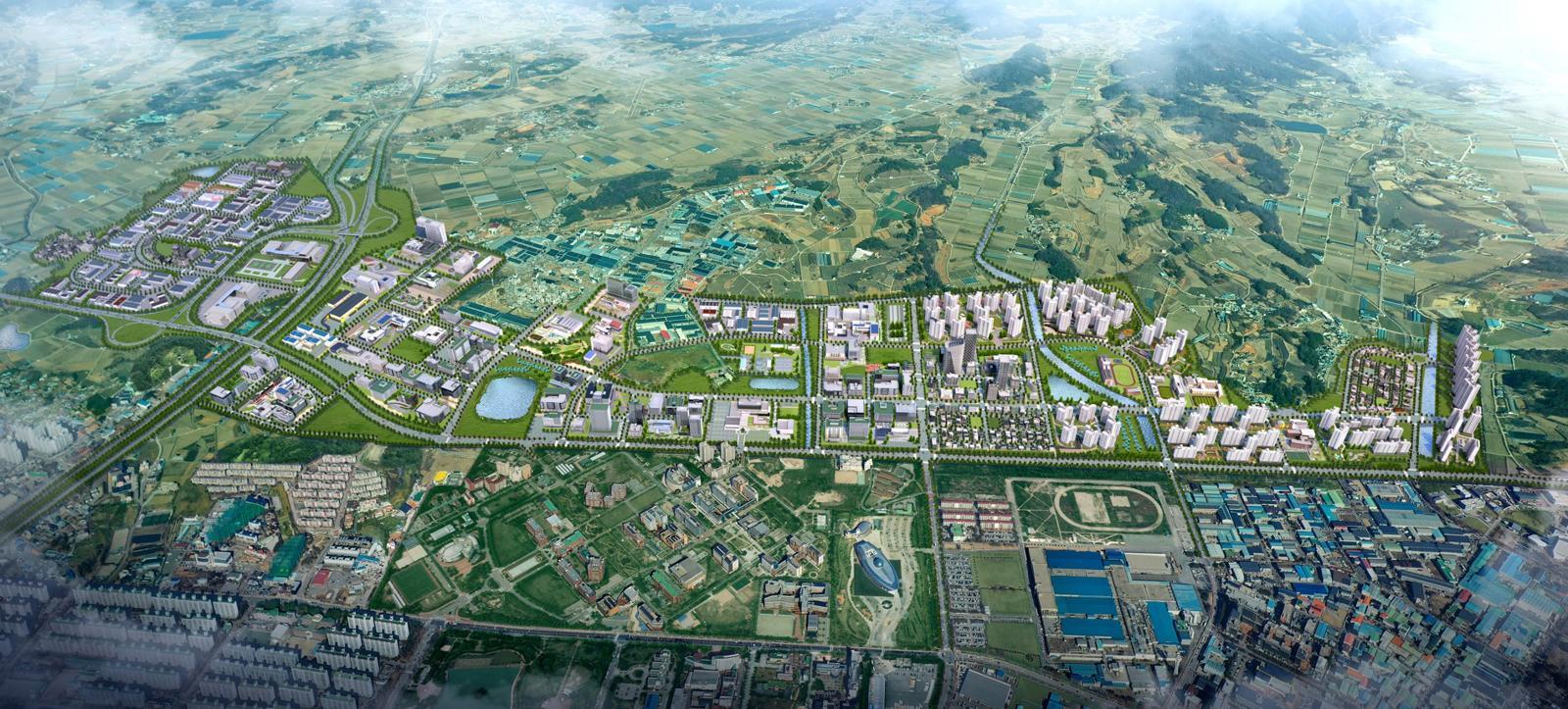
Gwangju R&D Innopolis Advanced District 3. (Provided by Gwangju Urban Corporation) / News1
The core of the “Republic of Korea Great Leap Forward Three Mega Projects,” to be announced on the 29th, is widely expected to be the Honam Semiconductor Cluster. Market expectations are that more than half of the total investment, which will exceed KRW 1,000 trillion, will be directed to Gwangju and South Jeolla Province. Since President Lee Jae-myung and Samsung Electronics Chairman Lee Jae-yong met on the 25th, prospects have strengthened for Samsung Electronics to invest in front-end semiconductor fabrication (fabs) in Gwangju and South Jeolla. Previously, SK reinforced the Gwangju–South Jeolla semiconductor cluster through investment plans spanning front-end fabs, energy storage systems (ESS), and artificial intelligence (AI) data centers.
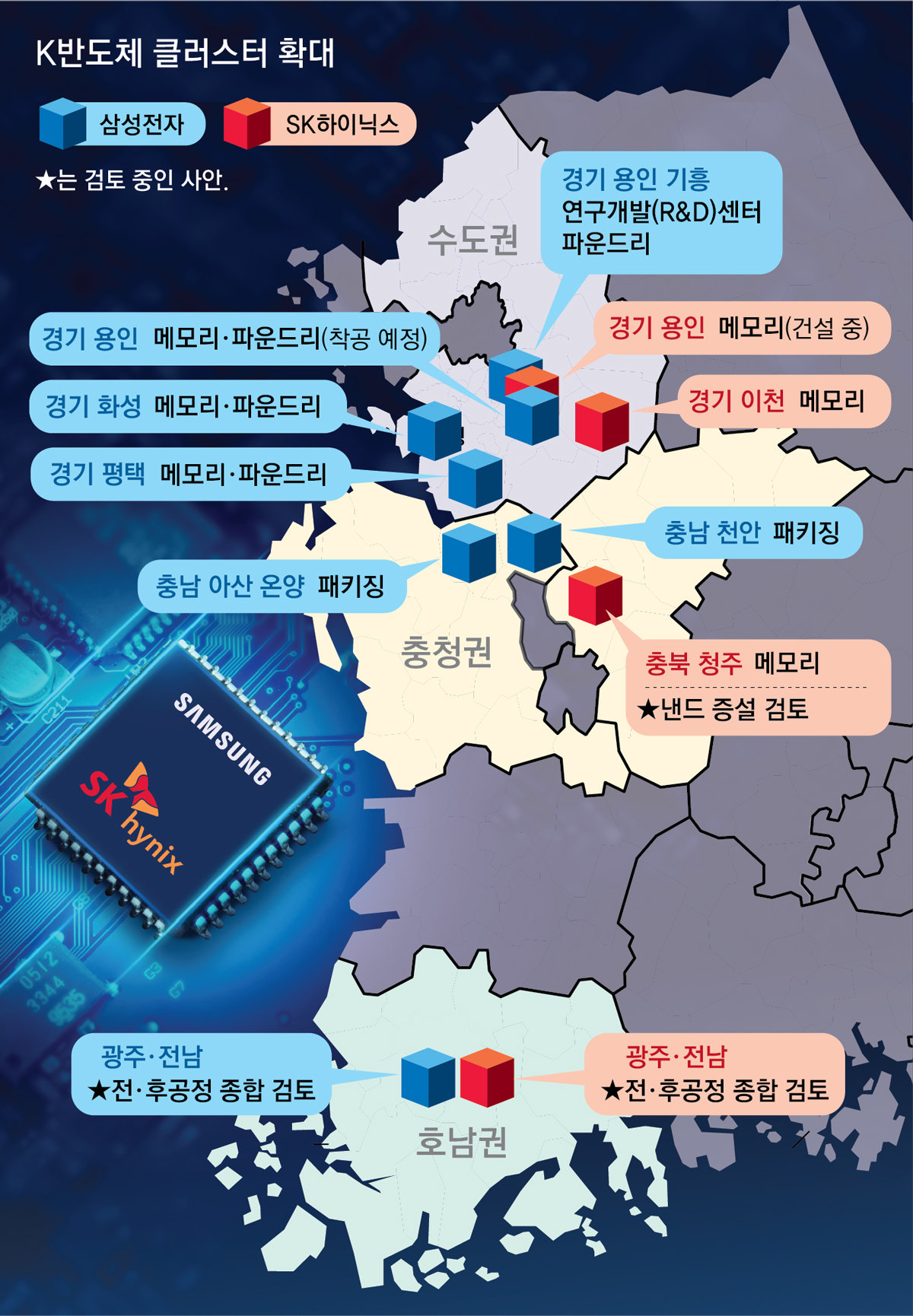
If these investments materialize, the long-standing Seoul metropolitan area–centered domestic semiconductor industry landscape will inevitably undergo change. The existing concentration in the capital region would expand into a memory and packaging cluster in the Chungcheong region and a large-scale integrated cluster in the Honam region.
● Samsung also leaning toward new fabs in Gwangju and South JeollaThe reason Samsung Electronics and SK Hynix have turned their attention to a “southward policy” for semiconductor fabs, which had previously been reluctant to leave the Seoul metropolitan area, is the growing likelihood that the AI-driven surge in semiconductor demand will continue over the long term.
Initially, SK Hynix took a more proactive stance toward the Gwangju–South Jeolla semiconductor cluster. With its Yongin cluster in Gyeonggi Province scheduled to start operations next year, the company faced the need to plan additional facility investments. To bypass the limitations of metropolitan infrastructure, it reviewed Gwangju and South Jeolla as next-generation front-end and back-end processing complexes.
Samsung Electronics has somewhat more time in drawing up plans for new production facility investments. Alongside expanding its Pyeongtaek campus in Gyeonggi Province, Samsung is pursuing the establishment of the Yongin National Industrial Complex for advanced system semiconductors as a mid- to long-term project. As the Yongin plant is still at the land compensation stage and has yet to break ground, there is little immediate need to finalize expansion investments. For this reason, Samsung had been pushing mainly for back-end semiconductor investments in Gwangju.
However, the situation has shifted as SK Hynix’s preemptive moves have combined with the government’s policy focus on balanced regional development. It is reported that during the roughly one-hour meeting between President Lee and Chairman Lee on the 25th, the main topic of discussion was Samsung Electronics’ semiconductor investment in Gwangju and South Jeolla.
If both Samsung Electronics and SK Hynix finalize investments in a semiconductor cluster in the Gwangju–South Jeolla region that encompasses both front-end and back-end processes, the domestic semiconductor industry ecosystem will undergo a fundamental tectonic shift. Hundreds of partner companies that supply materials, components, and equipment (MCE) to the top two semiconductor firms would also need to relocate their bases or build new facilities in Gwangju and South Jeolla.
● Capital region–Chungcheong–Honam as three major clusters After President Lee and the heads of major conglomerates announce the three mega projects at the event on the 29th, SK is expected to lead a southwest-region investment event in Gwangju on the 30th, followed by Samsung hosting a Chungcheong-region investment event in Asan, South Chungcheong Province, on the 2nd of next month.
The Chungcheong region, where Samsung Electronics and SK Hynix already maintain back-end processing bases, is expected to serve as a bridge connecting the semiconductor clusters in the capital region and Honam. In connection with the new regional investment plans, Samsung Electronics is reportedly reviewing a plan to further advance back-end processes at its existing Cheonan and Onyang campuses. SK Hynix is likewise pursuing an expansion of its NAND flash plant in Cheongju, North Chungcheong Province.
Park Soo-hyun, governor-elect of South Chungcheong Province, said, “Large corporate investment is extremely important and must proceed at speed,” adding, “In the Chungcheong region, the Cheonan–Asan area, given its geographical advantages and existing industrial infrastructure, can form a semiconductor cluster through large-scale investment.”
Investment in AI data centers and physical AI will also continue. GS Group plans to build gigawatt (GW)-scale AI data centers in Dangjin, South Chungcheong Province, and Donghae, Gangwon Province. In the Yeongnam region, companies such as Hanwha and Doosan are expected to step up investment in physical AI, including space and robotics, centered on Changwon and Sacheon in South Gyeongsang Province.
However, as large-scale investment becomes concentrated in Honam, opposition is growing in other regions. Lawmakers from the Daegu–North Gyeongsang area of the People Power Party held a press conference the same day, stating, “There are many voices of concern regarding the government’s reported plans to create a second national semiconductor cluster in Gwangju and South Jeolla,” and arguing, “Industrial policy must not be swayed by political logic under the pretext of national balanced development.”
ⓒ dongA.com. All rights reserved. Reproduction, redistribution, or use for AI training prohibited.
Popular News








 About Dong-A Ilbo