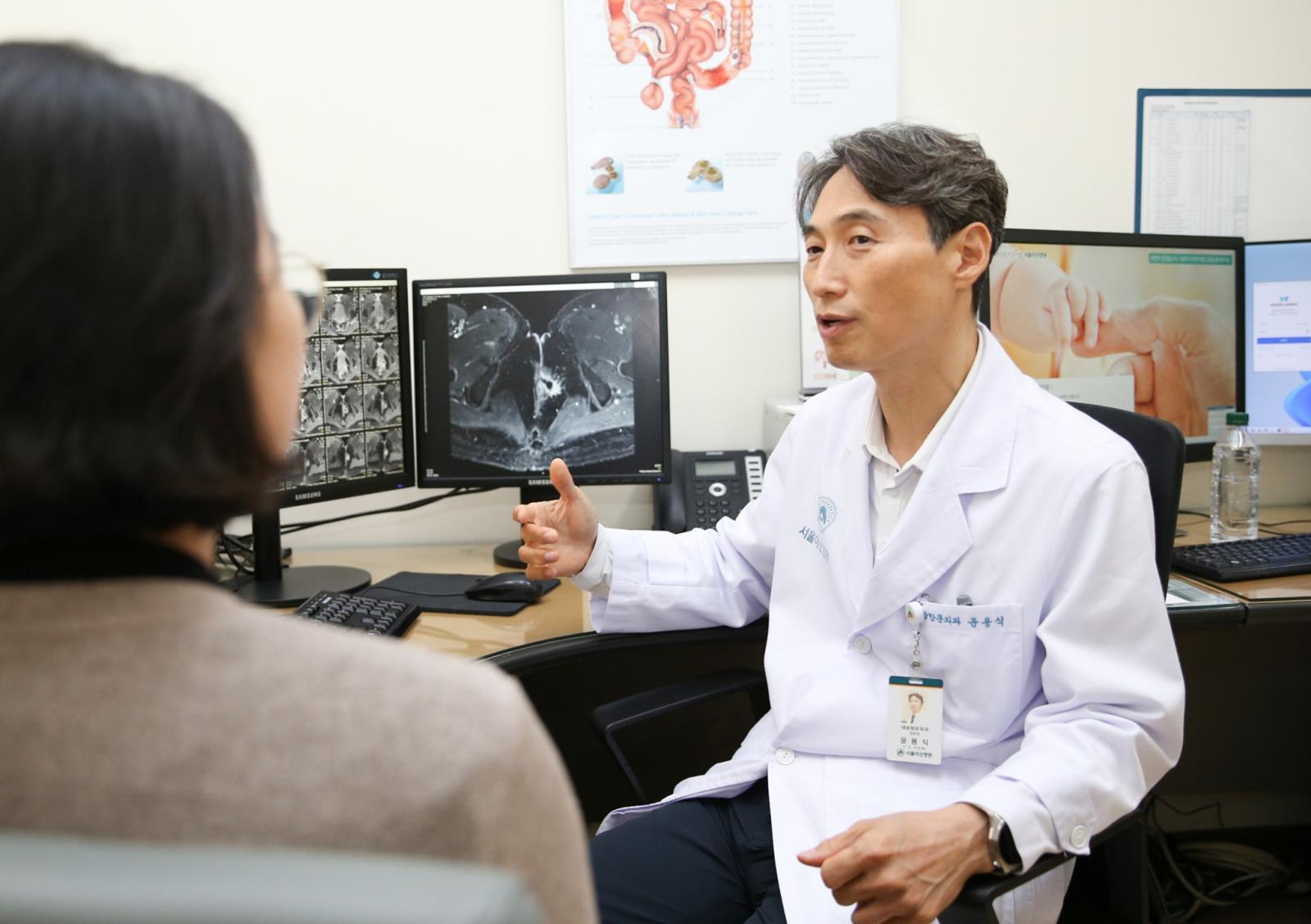
Professor Yoon Yong-sik of the Division of Colon and Rectal Surgery at Asan Medical Center in Seoul examines a patient with Crohn’s disease-related perianal fistula. Courtesy of Asan Medical Center
“Crohn’s disease perianal fistula,” which is characterized by frequent recurrence and treatment difficulty, remains a longstanding challenge for both patients and medical staff. Stem cell therapy, currently regarded as the most effective treatment, has limited real-world use due to its high cost and complex manufacturing process. Against this backdrop, a Korean research team has drawn attention by publishing findings that polydexyribonucleotide (PDRN), a regenerative substance extracted from salmon DNA, can improve the cure rate of Crohn’s disease perianal fistula and shorten treatment duration.
The research team led by Professor Yoon Yong-sik and Professor Lee Jong-ryul of the Division of Colon and Rectal Surgery at Asan Medical Center in Seoul reported that analysis of outcomes in patients who received local injections of PDRN during surgery for Crohn’s disease perianal fistula showed a marked improvement in treatment effectiveness compared with conventional surgical methods. The results were published in the latest issue of “Inflammatory Bowel Diseases (IBD),” an international journal specializing in Crohn’s disease and colitis.
Crohn’s disease is a condition in which chronic inflammation occurs throughout the gastrointestinal tract, from the mouth to the anus. A significant proportion of patients experience perianal fistulas, which are pus-filled tracts around the anus. Crohn’s disease-related perianal fistula is a representative complication that causes pain, discharge, and recurrent inflammation, severely reducing quality of life. Compared with ordinary fistulas, it has a higher recurrence rate and slower wound healing, making treatment particularly challenging.
Currently, surgery and drug therapy are used to treat Crohn’s disease perianal fistula, and stem cell therapy, with a success rate of around 70%, is regarded as the most effective option. However, there have been persistent concerns that patient access is limited due to costs that can reach tens of millions of KRW and complex manufacturing processes.
PDRN, which drew the attention of the research team, is a substance produced by purifying fragments of DNA extracted from salmon testes. It is known to promote cell regeneration and suppress inflammation, and to have a high safety profile because its structure is similar to that of human DNA. It is currently used for skin regeneration and scar treatment, corneal injury recovery, and treatment of joint and ligament damage.
The team focused on the fact that PDRN activates adenosine A2A receptors on the cell membrane, suppresses inflammation, and promotes angiogenesis, thereby supporting tissue regeneration and wound healing. Based on this, they applied a standardized surgical technique that evenly injects PDRN around the fistula tract and analyzed its therapeutic effect.
The study was conducted on 47 patients who underwent surgery for Crohn’s disease perianal fistula at Asan Medical Center in Seoul between 2018 and 2024. Of these, 21 patients received PDRN, while 26 did not.
Analysis showed that one year after surgery, the rate of complete fistula closure was 83.3% in the PDRN group. This was approximately 1.8 times higher than the 46.2% observed in the non-PDRN group. Recovery was also faster. The average time to complete cure was 3.3 months in the PDRN group, about 2.6 months shorter than the 5.9 months in the non-PDRN group.
Another advantage of PDRN is cost-effectiveness. According to the research team, the cost of PDRN is only about one-hundredth that of conventional stem cell therapy. As it can be used as a ready-made product without separate cell culture processes, it can significantly improve access to treatment.
Professor Yoon stated, “We have identified a new possibility for improving the chronically low cure rate and high recurrence rate that have long plagued treatment of Crohn’s disease perianal fistula,” and added, “PDRN is a substance whose safety has already been verified and can be applied relatively easily not only in surgery but also in outpatient settings, so it is expected to help improve patients’ quality of life and reduce their economic burden.”
This study is significant in that it is the first in the world to apply PDRN to the treatment of Crohn’s disease perianal fistula and demonstrate its efficacy. The research team plans to further verify its therapeutic effect and safety through follow-up studies involving a larger number of patients.
ⓒ dongA.com. All rights reserved. Reproduction, redistribution, or use for AI training prohibited.
Popular News










 About Dong-A Ilbo