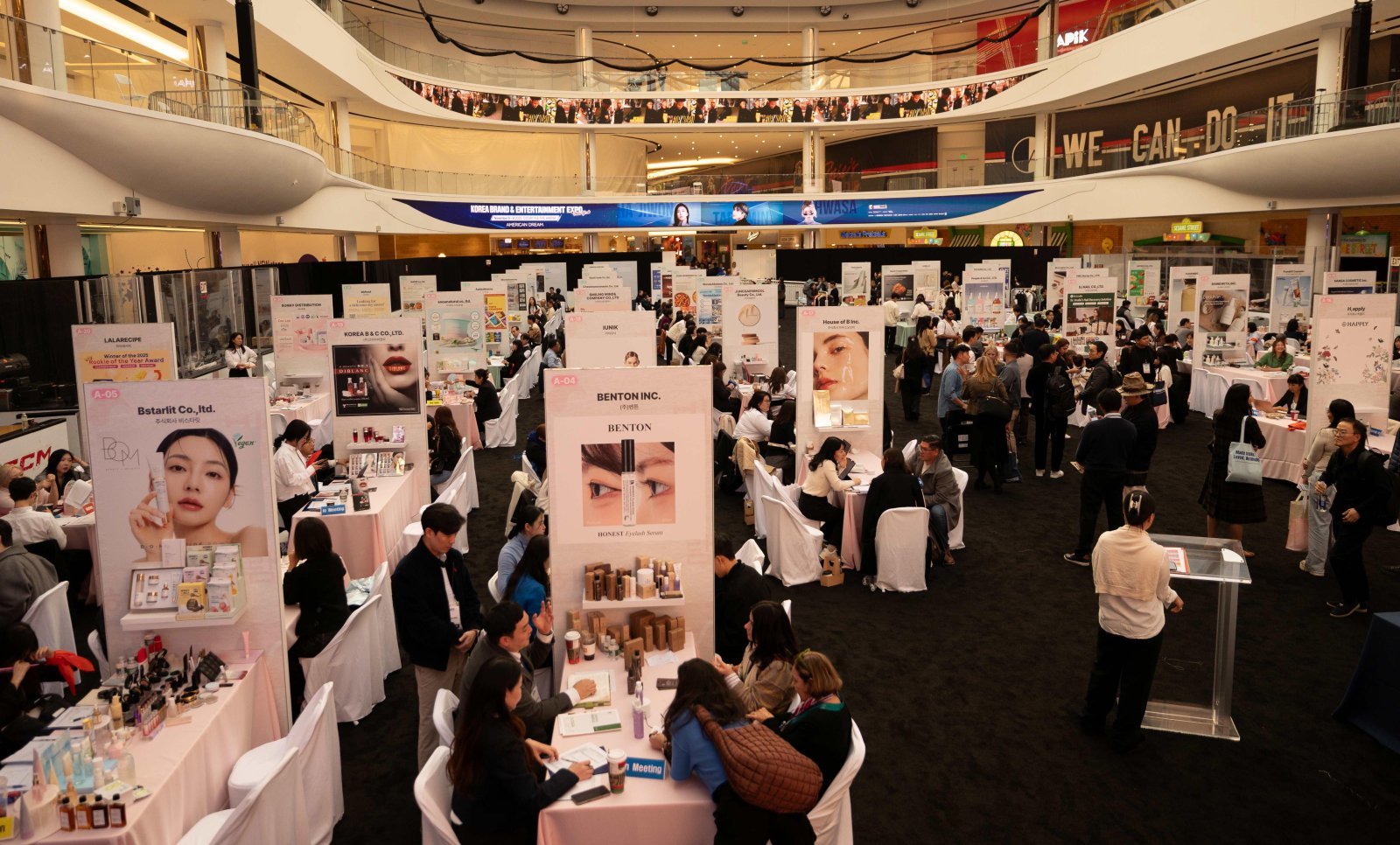
At the “2025 New York Hallyu Expo” held in the United States last November, KOTRA facilitated one-on-one consultations between domestic companies and overseas buyers. Provided by KOTRA
Despite high-tariff barriers originating from the United States, Korea’s export growth, which last year surpassed the USD 700 billion mark to rank sixth in the world, is not slowing even amid the new crisis of the war in Iran this year. According to provisional tallies from the Korea Customs Service, exports for January–May this year reached USD 394.2 billion, up 43% from the same period a year earlier. The Organisation for Economic Co-operation and Development (OECD) reported that in the first quarter (January–March) of this year, Korea’s export growth rate (38.0%) ranked first among the Group of Twenty (G20), outpacing the United States (15.4%), China (14.5%), and Japan (7.0%). In line with this quantitative growth, KOTRA is working to achieve USD 1 trillion in exports this year through qualitative structural improvements by diversifying export items, markets, exporters, and methods.
● Non-semiconductor exports make a contribution… diversification of items
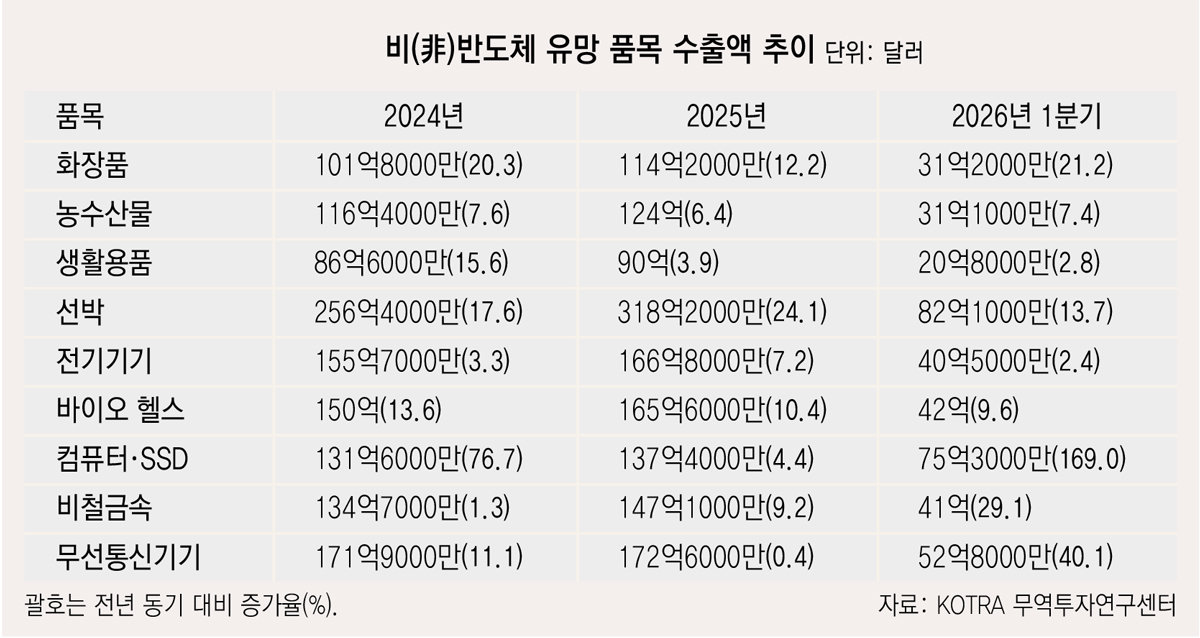
The surge in exports has largely benefited from the semiconductor “super cycle” (boom) driven by expanded investment in artificial intelligence (AI) infrastructure. However, growth in non-semiconductor exports, which accounted for 63% of total exports last year, also played a significant role. In particular, exports of consumer goods, bio-health, nuclear power and power equipment, defense, shipbuilding, and AI-robot-based smart industries increased 14% year-on-year in January–May this year.
The five major categories of consumer goods—beauty, fashion, food, pharmaceuticals, and household goods—saw export growth extend beyond the United States, China, and Japan to Europe, the Middle East, and Latin America, led by strong demand for cosmetics and food. In tandem with the K-culture boom, this has also contributed to improving brand favorability for Korean export items. Cosmetics were exported to 202 countries last year, making Korea the world’s second-largest exporter (USD 11.4 billion) after France. A buyer from a United Arab Emirates (UAE) distribution network even stated that “even if war forces a shift from sea to air transport at my own expense, I will expand imports of K-beauty products.”
Disruptions to oil and gas supply chains caused by the wars in Ukraine and Iran have sharpened the trend toward reducing dependence on fossil fuels, driving up demand for nuclear power and renewable energy-related power equipment as well as transmission and distribution systems.
Since the COVID-19 pandemic, recognition of Korean medical capabilities has risen, leading to increased demand in medical areas such as pharmaceuticals, medical devices, and services. In addition, the convergence of digital health and the beauty industry is creating favorable conditions for exports.
The wars in Europe and the Middle East have sharply boosted trust in Korean defense products. Beyond large weapons systems, exports of defense items are expected to grow further on the back of increased demand for drones, underground fortification equipment, medium- and short-range interception systems, and cyber security equipment.
In addition to demand from major U.S. tech companies, countries such as the UAE, Saudi Arabia, and Qatar, as well as ASEAN members including Vietnam and Malaysia, are increasingly looking to Korea as a partner for AI and robotics cooperation, which is expected to act as a catalyst for exports in smart industries.
● From U.S. and China to EU–ASEAN–Middle East–Latin AmericaExport markets are also diversifying away from a focus on the United States and China toward the European Union (EU), ASEAN, India, Japan, the Middle East, and Latin America, where both market share and absolute export volume have increased. In last year’s exports, China’s share declined for the fourth consecutive year, while exports to the United States grew only in the 1% range. By contrast, exports to the EU and other regions rose by 3.1 percentage points. Further export opportunities are anticipated.
Following the outbreak of war in Iran, demand in the UAE, Saudi Arabia, and Qatar is expected to surge not only for reconstruction but also for their pre-existing digital and AI transformation needs. The accelerated shift away from oil-based economies in the Middle East also presents export opportunities.
In Europe, exports of defense products, nuclear power and power equipment, and food, cosmetics, and pharmaceuticals are rising sharply. Switzerland (USD 1.3 billion), Hungary (USD 900 million), and the Netherlands (USD 800 million) rank second to fourth as destinations for pharmaceutical exports. In defense, Korea has signed major contracts with Finland and Estonia following Poland. As seen in the Czech nuclear power project award, Korea has built a strong reputation for meeting deadlines and contract prices for nuclear power and power equipment. Latin America, which is emerging as a production base for global companies due to U.S.-driven high tariffs, is promising for intermediate goods exports. ASEAN and India, where K-culture enjoys high favorability, also have scope for export market expansion.
The base of exporting companies is diversifying as well. Since the current administration took office, the number of small and medium-sized exporters exceeded 100,000 for the first time. Exports by small and medium-sized enterprises have also recovered, rising 9.1% from USD 27.3 billion in the first quarter of last year to USD 29.8 billion in the first quarter of this year.
KOTRA is supporting 1,000 micro-sized local firms over five years through the “1,000 Export Hopefuls” program, and 500 companies with annual exports of USD 10 million over five years through the “500 Export Stars” initiative.
It is also operating an “AI Export Assistant” that integrates 20 types of export-related data using AI technology. At 20 “AI Trade Support Centers” nationwide, KOTRA provides integrated support for overseas marketing, including the production of promotional content, recommendations for promising markets and buyers, and both online and offline marketing.
Kang Kyung-sung, President and CEO of KOTRA, stated, “The strong export performance is significant in that companies and the government have devoted their utmost efforts not only to quantitative growth but also to qualitative growth through diversification of items, markets, exporters, and methods,” adding, “KOTRA will make every effort to capture emerging opportunities in overseas markets to ensure the continued growth of exports.”
ⓒ dongA.com. All rights reserved. Reproduction, redistribution, or use for AI training prohibited.
Popular News









 About Dong-A Ilbo