Korea, a “manufacturing powerhouse” with world‑class IT infrastructure, emerges as a key stage for next‑generation physical AI business
Jensen Huang holds wide‑ranging meetings with SK, Hyundai Motor and others
“Korea, an outstanding AI‑robotics manufacturing hub”… AWS and Google also court Korean firms for partnerships
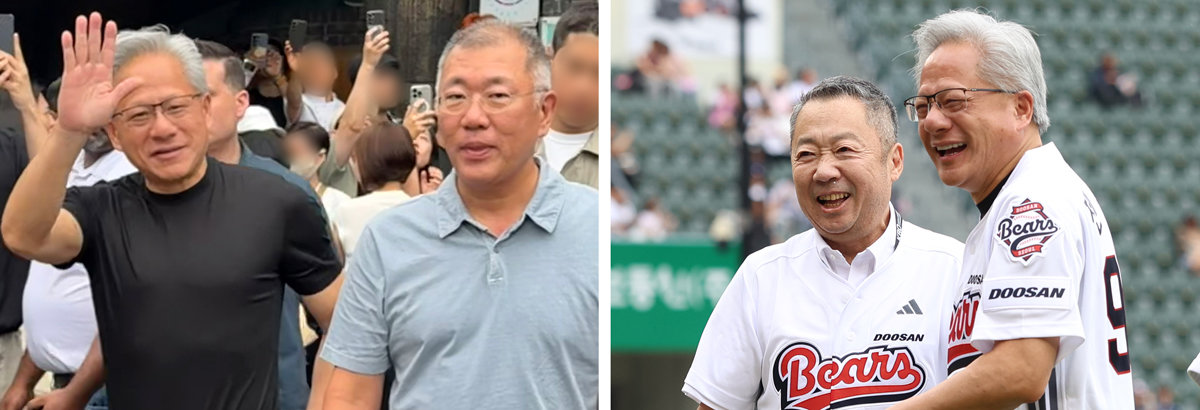
Jensen Huang, series of meetings with Korean business leaders at naengmyeon restaurant, baseball stadium, and elsewhere Jensen Huang, CEO of Nvidia, crisscrossed Seoul even on Saturday the 7th. He had lunch with Hyundai Motor Group Chairman Chung Euisun at “Wooraeok” in Jung District, central Seoul (left photo), and threw out the ceremonial first pitch at Jamsil Baseball Stadium wearing a Doosan Bears uniform. Doosan Group Chairman Park Jeong-won responded by taking the ceremonial first swing. News1 · Doosan
Jensen Huang, CEO of Nvidia, has returned to Korea roughly seven months after his previous visit in October last year, holding a series of meetings with domestic companies. Behind this move lies a strategic intent to secure a leading position in “physical AI,” seen as the next major battleground in artificial intelligence (AI).
In particular, Korea has manufacturing bases spanning virtually all industrial sectors, including semiconductors, automobiles, steel, shipbuilding, chemicals, smartphones, and home appliances, drawing attention as an ideal physical AI testbed for U.S. Big Tech firms. Although China also has an advanced manufacturing base, within the context of the U.S.-China hegemonic rivalry, Korea is viewed as unmatched when it comes to building stable supply chain cooperation with U.S. Big Tech.
Kim Dae-jong, professor of business administration at Sejong University, said, “The manufacturing data accumulated over decades by Korean companies in shipbuilding, steel, and machinery has considerable value in the field of physical AI.”
● “Manufacturing hub Korea” as the optimal testbedAccording to the information technology (IT) industry on the 7th, global Big Tech companies are viewing Korea as the optimal physical AI testbed and are actively expanding cooperation with domestic firms. Physical AI refers to AI that moves beyond existing digital environments into the real world, directly influencing the physical environments where people live.
Robotics is attracting the most attention as a form of physical AI, but there is also growing anticipation for new business opportunities in areas such as autonomous driving, smart factories, and smart cities. Korea, a manufacturing powerhouse with excellent IT infrastructure, is thus receiving strong “love calls” from Big Tech. After arriving in Korea on the 5th, CEO Huang told reporters, “Korea has outstanding expertise in AI and robotics and is a world-class manufacturing hub.”
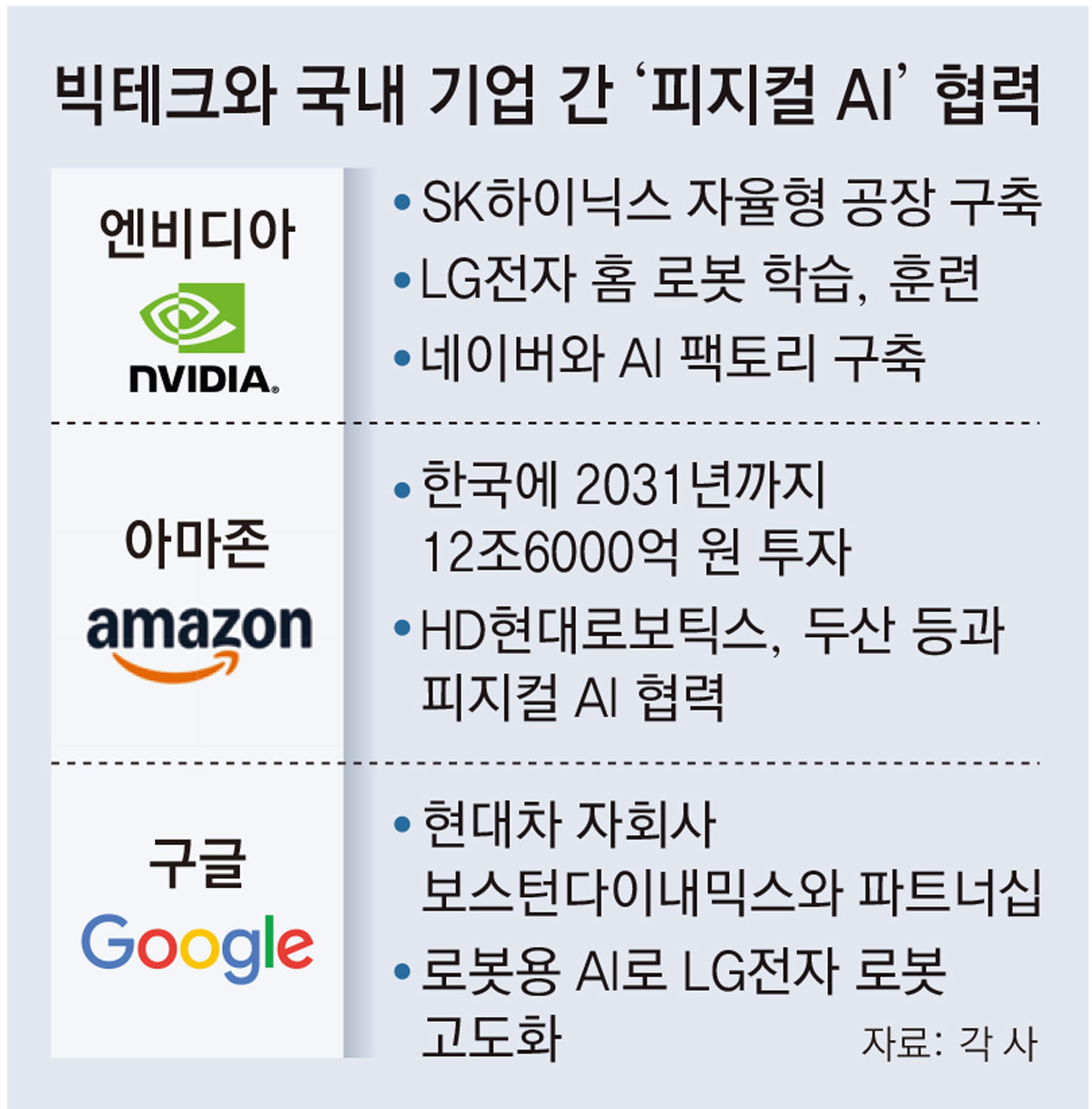
In practice, Nvidia recently presented a vision for building an autonomous semiconductor plant with SK Telecom and SK hynix at GTC Taipei, an Asian IT exhibition held in Taiwan. The plan is to use “digital twin” technology, which fully replicates real plants and equipment in virtual space, to complete the project in stages by 2030. SK hynix can use this to correct problems or inefficiencies that arise during plant operations and further advance its processes. In March, Naver Cloud attracted attention by unveiling the “Seoul World Model,” a virtual implementation of actual spaces in Seoul, using Nvidia’s physical AI platform “Cosmos.”
● AWS and Google also making overtures
Another Big Tech firm, Amazon Web Services (AWS), plans to invest KRW 12.6 trillion in Korea’s AI industry by 2031. AWS Chief Financial Officer John Felton stated at the “AWS Summit Seoul 2026” event last month that “physical AI is fundamentally changing the paradigm of AI,” and emphasized that “Korea is one of the most strategically important ecosystems in the world today.”
DeepMind, Google’s AI development subsidiary, entered into a strategic partnership in January with Boston Dynamics, a Hyundai Motor affiliate. As the first outcome of this collaboration, it drew attention in April by unveiling “Spot,” a quadruped walking robot equipped with Google’s robotics AI “Gemini Robotics.”
Analysts believe that CEO Huang’s wide-ranging meetings during this visit with top management at SK, Hyundai Motor, LG, Doosan, Naver, Krafton, and NCSoft are aimed at securing an early lead in Korea’s physical AI market amid competition with other Big Tech firms. Nvidia has grown rapidly on the back of AI accelerators, but as Google’s Tensor Processing Unit (TPU)—designed and developed with Broadcom—has emerged as a rival, and as central processing units (CPUs) are gaining attention with the expansion of the AI inference market, the semiconductor landscape is diversifying, forcing Nvidia to target next-generation markets. Kim Jae-gu, professor of business administration at Myongji University, said, “Nvidia has been an absolute powerhouse in AI chips to date, but in physical AI, where manufacturing capabilities are crucial, cooperation with partners is essential,” adding, “To preempt new markets and sustain growth momentum, it is actively seeking out Korean companies.”
ⓒ dongA.com. All rights reserved. Reproduction, redistribution, or use for AI training prohibited.
Popular News








 About Dong-A Ilbo