Prof. Lee Ji-yeon, Division of Hematology-Oncology, and Prof. An Ji-young, Division of Gastrointestinal Surgery, Samsung Medical Center
Surgery performed after reducing tumor size in the stomach
Expected benefits in recurrence prevention and survival improvement
Durvalumab approved for adjuvant therapy indication
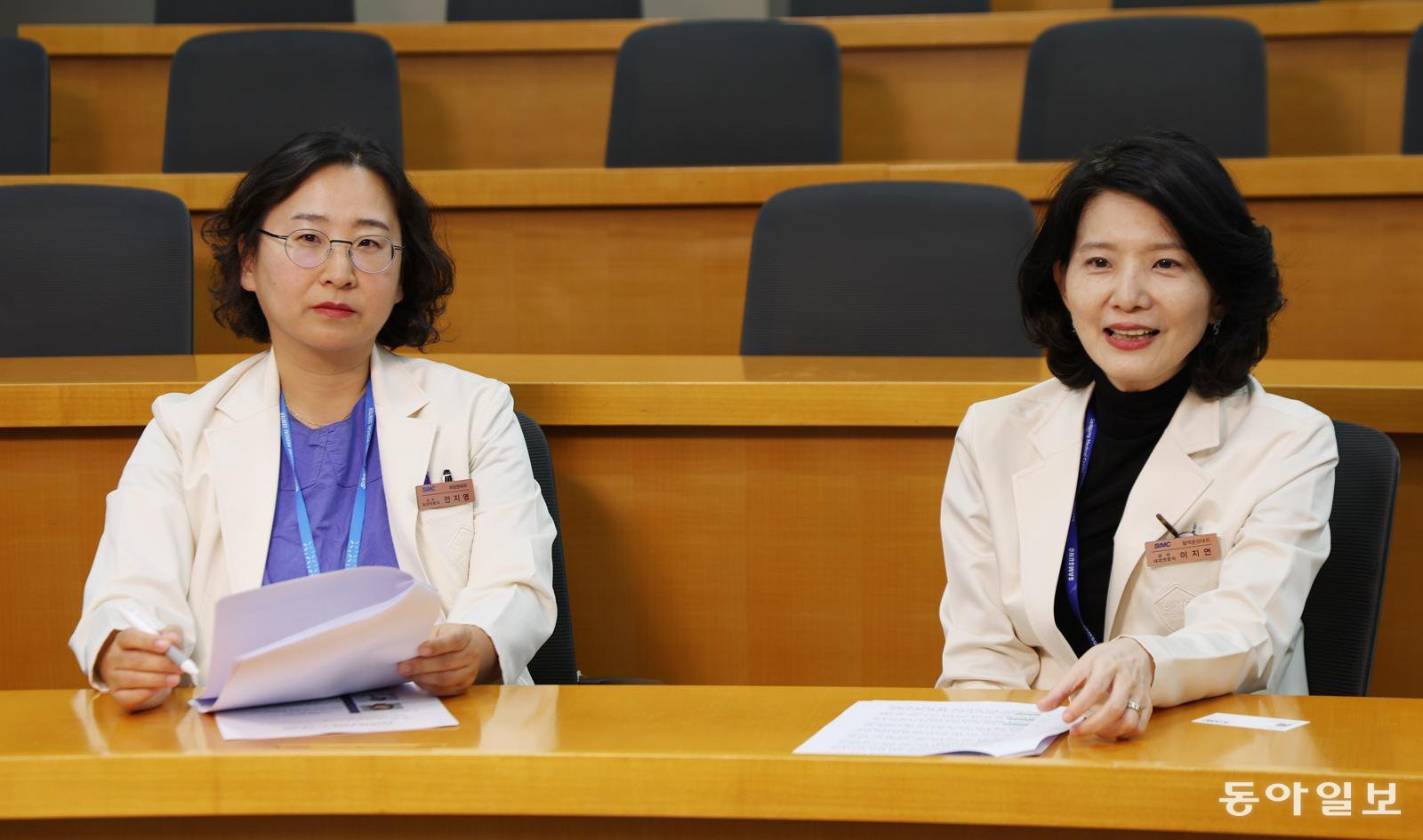
Professor Lee Ji-yeon of the Division of Hematology-Oncology at Samsung Medical Center (right) and Professor Ahn Ji-young of the Division of Gastrointestinal Surgery are explaining the newly approved perioperative adjuvant therapy for gastric cancer in Korea. Photo by reporter Shin Won-gun laputa@donga.com
Gastric cancer is a disease in which the risk of recurrence remains depending on the cancer stage, even when the tumor is completely removed by surgery. In fact, it is known that stage 2 gastric cancer recurs in about 20% of cases and stage 3 gastric cancer in about 40%. The pattern of recurrence is also diverse, including peritoneal dissemination and lymph node metastasis. In particular, for stage 3 patients, there has been a steady recognition of the limitations of conventional treatment because invisible micrometastases present at the time of surgery are highly likely to lead to recurrence. As a result, treatment methods that use anticancer drugs before and after surgery are being emphasized in order to reduce the recurrence rate and improve long-term survival rates.
Recently, the immune checkpoint inhibitor durvalumab has received Korea’s first approval in the gastric cancer field as a perioperative adjuvant therapy, prompting assessments that a shift in the treatment paradigm has begun. It is expected that an integrated approach that combines systemic therapy with surgery-centered treatment will become fully established. The Dong-A Ilbo interviewed Professor Lee Ji-yeon of the Division of Hematology-Oncology and Professor Ahn Ji-young of the Division of Gastrointestinal Surgery at Samsung Medical Center for more details.
―What is the current level of gastric cancer treatment in Korea and the global trend?Professor Ahn Ji-young = “Korea’s surgical outcomes for gastric cancer are among the best in the world. However, current gastric cancer treatment is evolving beyond the stage of simply removing the tumor to a direction that also considers the patient’s quality of life. To this end, a sophisticated strategy that takes into account both the patient’s clinical characteristics and the tumor’s characteristics is required. For example, if preservation of function is overemphasized in patients with advanced gastric cancer, the risk of recurrence may increase, while applying a uniform standard surgery to all early gastric cancer patients may result in overtreatment. Recently, by using ‘perioperative adjuvant therapy’—combining immunotherapy and chemotherapy before surgery to reduce tumor size and then operating—both prognosis and quality of life are being improved.”
―Does the recently approved durvalumab perioperative regimen also reflect this trend?Professor Lee Ji-yeon = “Yes. The MATTERHORN clinical trial, which evaluated the efficacy of perioperative durvalumab adjuvant therapy, is a groundbreaking study that changes the treatment paradigm for gastric cancer in Korea. Until now, data on preoperative chemotherapy have been mainly accumulated in Western patients, which limited direct application to Asian patients. In contrast, this study included both Asian and Western patients. It is also noteworthy that it confirmed significant results in terms of recurrence reduction regardless of regional or treatment-practice differences and the presence or absence of biomarkers (biological indicators that can detect changes in the body).”
―In which patient group is the clinical value expected to be greatest?Professor Lee = “The decision on whether to administer preoperative chemotherapy is made through detailed assessment by computed tomography (CT) scans of how deeply cancer cells have infiltrated the gastric wall and whether they have spread to nearby lymph nodes. In particular, it is expected that this treatment will have a substantial effect in preventing recurrence and improving survival when applied to patients at stages 3–4, where the cancer has extensively invaded the gastric wall, or to those with confirmed regional lymph node metastasis and a high risk of recurrence.”
―How do patients react when they are about to undergo preoperative chemotherapy?Professor Ahn = “In the initial stages, because the cancer is not removed immediately, patients often experience considerable anxiety. To alleviate this, it is necessary to provide sufficient explanation about the entire treatment process. It is important to build trust by clearly conveying that the order of treatments is being adjusted according to the patient’s condition and that surgery itself is not being omitted.”
―What changes is this regimen expected to bring to the future treatment paradigm for gastric cancer?
Professor Ahn = “In the past, the completeness of surgery was the most important factor in achieving a cure, but now an integrated approach, in which systemic treatments such as anticancer drugs must be combined, has become the prevailing trend. In other words, surgery remains the central axis of treatment, but rather than being performed alone, it is being redefined as an optimized process that works in an organic combination with systemic therapy to achieve cure.”
Professor Lee = “The durvalumab adjuvant regimen is highly significant in that, based on global clinical evidence, it presents the first new standard treatment that can be applied in practice. Going forward, more precise treatment options tailored to patient characteristics and the biological features of the tumor are expected to develop further.”
―Multidisciplinary collaboration seems important. How is the collaborative care system organized at Samsung Medical Center?Professor Lee = “Multidisciplinary care at our hospital is very closely coordinated from the diagnostic stage. First, the Department of Radiology conducts precise assessments of tumor invasion depth and extent of metastasis based on CT imaging, and treatment direction is determined on the basis of these results. Thereafter, customized strategies are established through consultations between the surgical and medical teams. Taking into account the patient’s general condition, the feasibility and sequence of surgery are decided, and after surgery, surgical findings are shared and the Department of Pathology carefully evaluates, based on the resected tissue, whether the symptoms and signs of the disease have completely disappeared from a pathological perspective.”
―Finally, is there anything you would like to say to medical staff and patients?Professor Lee = “A cancer diagnosis is a major crisis for anyone. What is important is not to panic, but to trust the medical team and undergo treatment with hope. As important as the will to undergo treatment is alleviating the financial burden, so institutional support for patients must also be strengthened. In particular, it is hoped that health insurance coverage for the durvalumab adjuvant regimen will be implemented as soon as possible so that more patients can have access to the best treatment opportunities.”
ⓒ dongA.com. All rights reserved. Reproduction, redistribution, or use for AI training prohibited.
Popular News









 About Dong-A Ilbo