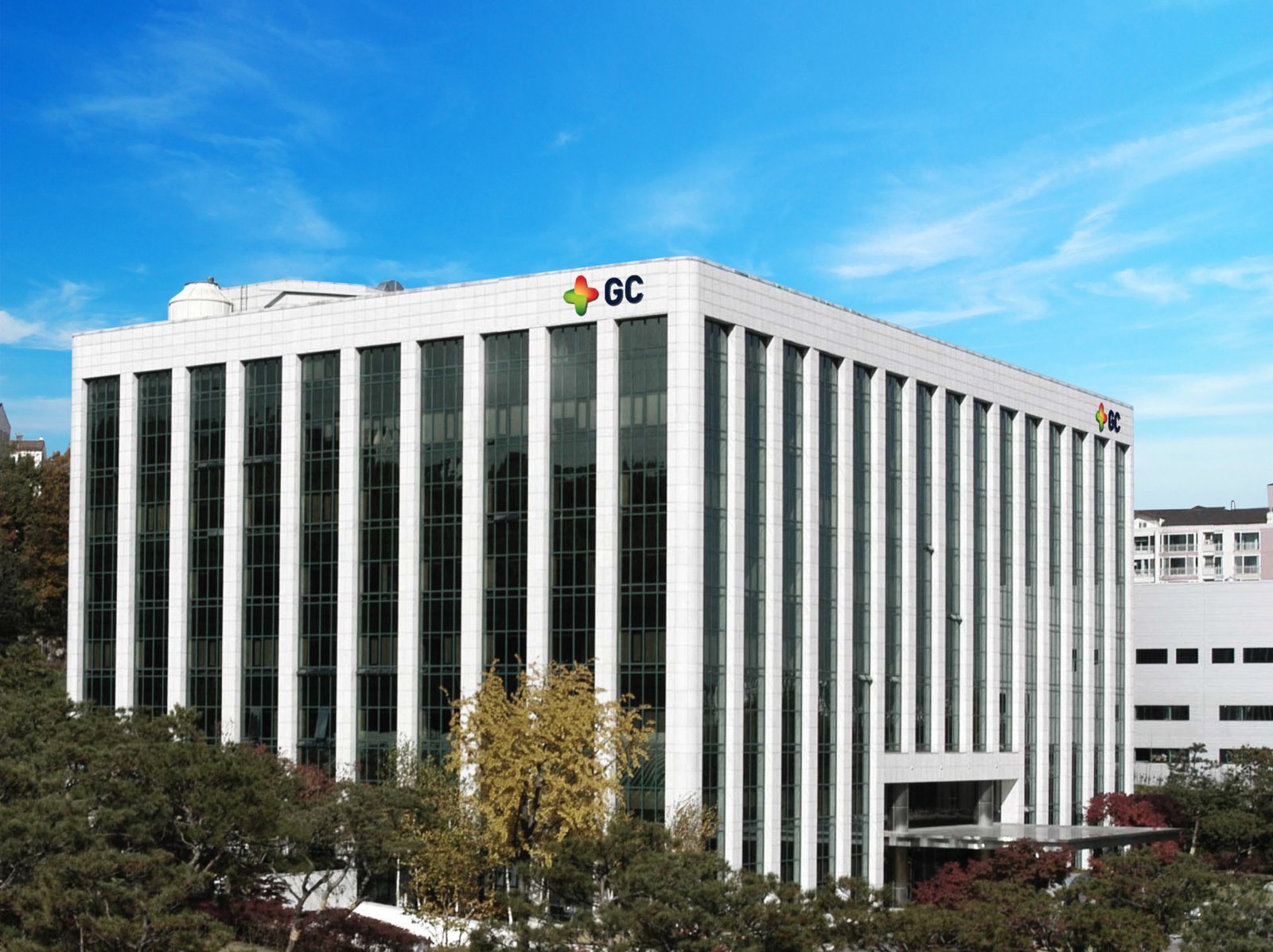
Panoramic view of GC Green Cross headquarters. Courtesy of GC Green Cross
GC Green Cross achieved improved earnings in the first quarter of this year, driven by the growth of its new immune globulin drug “ALYGLO.” The company is assessed to be entering a full-fledged phase of profitability recovery, supported by expansion in the U.S. market and stabilization of plasma supply.
On 8 May, GC Green Cross announced on a consolidated basis that it posted first-quarter revenue of KRW 435.5 billion and operating profit of KRW 11.7 billion. Compared with the same period a year earlier, revenue increased 13.5% and operating profit rose 46.3%. Net profit came in at KRW 20.1 billion.
The improved results were largely attributable to the growth of ALYGLO, an immune globulin preparation sold in the U.S. market. ALYGLO generated KRW 34.9 billion in revenue in the first quarter, about four times higher than in the same period last year. GC Green Cross expects the quarterly growth trend to continue as prescribing expands in the U.S. market.
ALYGLO is a plasma fractionation product launched by GC Green Cross after obtaining approval from the U.S. Food and Drug Administration (FDA). GC Green Cross has been seeking to move beyond its previous business structure centered on domestic influenza vaccines and blood products, and to expand into the global rare disease and immune disorder markets. In particular, the U.S. immune globulin market continues to grow steadily due to population aging and a rise in immune disorders, leading to analysis that ALYGLO is highly likely to become a core product for future earnings.
Partial resolution of uncertainties surrounding the U.S. business also had a positive impact. In the recently announced U.S. tariff policy, plasma fractionation products were included in the duty-free category, easing concerns over tariff burdens. Given that supply stability and price competitiveness are critical for blood products, the industry expects this measure to have a positive effect on domestic blood product manufacturers.
The expansion of the plasma supply chain is also under way. GC Green Cross is strengthening its local plasma procurement system through its U.S. plasma center subsidiary ABO Plasma. With the plasma center in Laredo, Texas recently obtaining FDA approval, the company’s plasma sourcing capability has expanded, and it is also pursuing the opening of an additional plasma center in Eagle Pass within the year.
The industry views the expansion of local plasma centers as a mid- to long-term growth foundation, as competition to secure plasma is regarded as a key variable in the global blood product market. In fact, global companies such as CSL Behring, Takeda, and Grifols are engaged in fierce competition to secure plasma centers in this field.
By business segment, plasma fractionation products accounted for the largest share, with revenue of KRW 114.9 billion. This was followed by prescription drugs at KRW 81.6 billion, vaccines at KRW 56.8 billion, and over-the-counter drugs and consumer healthcare at KRW 32.4 billion.
Results for consolidated subsidiaries were also disclosed. GC Cell and GC MS recorded revenue of KRW 37.4 billion and KRW 23.6 billion, respectively. GC Wellbeing posted revenue of KRW 49.1 billion, driven by sales of the obesity treatment “Mounjaro.” However, GC Green Cross sold its stake in GC Wellbeing to GC (Green Cross Holdings) in March, so GC Wellbeing will be excluded from the consolidated scope from the second quarter onward.
A GC Green Cross official said, “The company will continue the trend of earnings improvement based on the stable growth of key products.”
ⓒ dongA.com. All rights reserved. Reproduction, redistribution, or use for AI training prohibited.
Popular News








 About Dong-A Ilbo