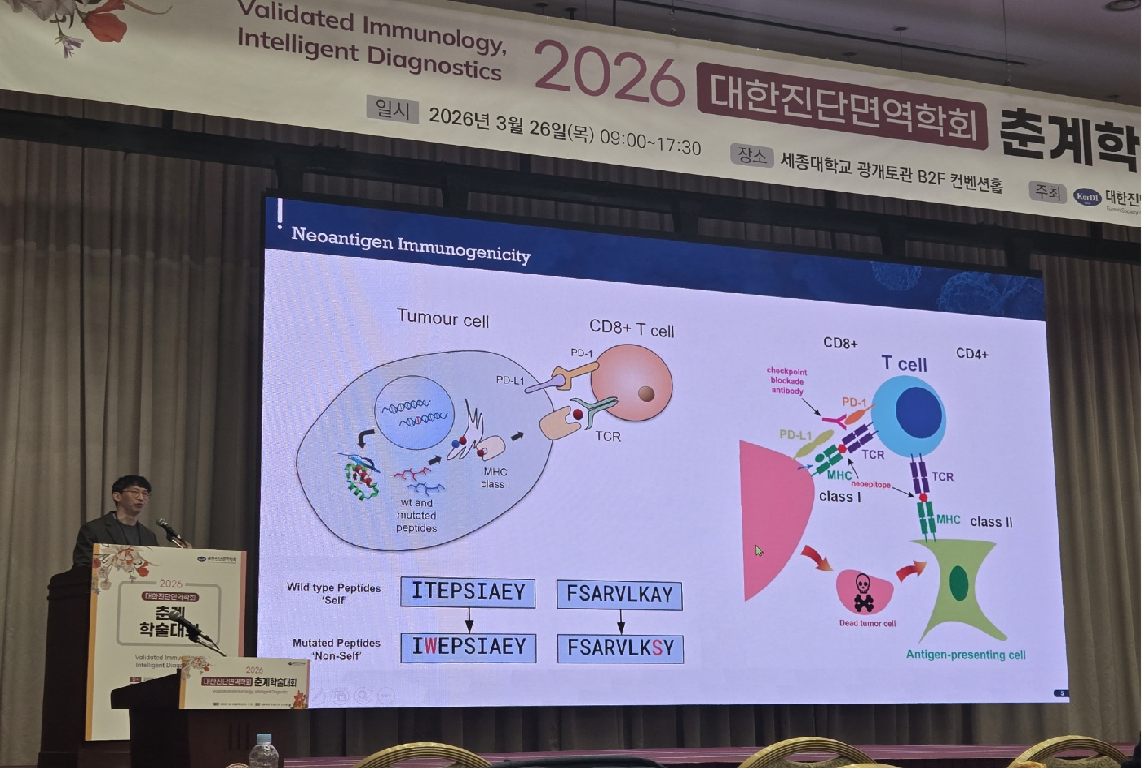
At the Spring Academic Conference of the Korean Association of Clinical Immunologists held on the 26th, Choi Jung-gyun, CEO of Neogen Logic, is explaining the anti-cancer vaccine AI model “Deep Neo” and the latest research achievements. Provided by SCL Science
SCL Science has presented an AI-based anti-cancer direction at the Korean Association of Clinical Immunologists. SCL Science announced on the 30th that its subsidiary Neogen Logic delivered a special lecture on the theme of “AI and Multi-Omics in Immuno-Oncology” at the association’s Spring Academic Conference.
Neogen Logic CEO Choi Jung-gyun, who delivered the special lecture, introduced the anti-cancer vaccine AI model “Deep Neo” and the latest research results. Choi is a professor in the Department of Bio and Brain Engineering at KAIST and recently drew academic attention by publishing in the international journal Science Advances research results that identified the importance of inducing B-cell responses in anti-cancer vaccines.
Deep Neo is a model that applies a protein language model, similar in approach to ChatGPT, to the discovery of neoantigens. SCL Science views the core objective as increasing the hit rate compared with existing prediction algorithms and believes it could also be used to discover new forms of neoantigens by leveraging “multi-omics” data that encompass biological information at the cellular level, which is more granular than the individual-patient level.
The foundation of this research achievement is the “single-cell big data warehouse” built by SCL Science. Through a technology transfer agreement with KAIST last year, SCL Science announced the construction of this database, which integrates multi-omics information at the cellular level. The research results of Deep Neo are also a product of utilizing this database.
SCL Science is an affiliate of the SCL Group and is developing digital healthcare and AI businesses based on medical data generated by Hanaro Medical Foundation, another group company, in the course of health checkups and clinical practice. Building on this in-group data infrastructure, the company entered the anti-cancer vaccine business by acquiring Neogen Logic in September last year. Its plan is to grow into a next-generation precision medicine company by combining its own precision medical data infrastructure with Neogen Logic’s AI technology. For now, additional clinical validation and time are needed before the integration of the two companies’ technologies can translate into tangible business results.
Interest in the anti-cancer vaccine field from both the market and academia has increased further this year. In January, Moderna announced five-year follow-up results from a Phase 2 clinical trial in melanoma patients, stating that when an anti-cancer vaccine is administered in combination with an immune checkpoint inhibitor, the risk of recurrence decreases by 49%. Although still at the clinical stage, this result is assessed as adding weight to the commercial potential of anti-cancer vaccines.
SCL Science intends to seize this market trend as a business opportunity, but for neoantigen-based anti-cancer vaccines, large-scale production and cost optimization are cited as key challenges to commercialization due to their personalized manufacturing characteristics. The extent to which Deep Neo’s prediction accuracy is validated in actual clinical settings is expected to be a key variable in gauging the company’s future business competitiveness.
ⓒ dongA.com. All rights reserved. Reproduction, redistribution, or use for AI training prohibited.
Popular News







 About Dong-A Ilbo