Global big tech companies are pouring their entire corporate capabilities into artificial intelligence (AI). In the ultimately “winner-takes-all” AI market, they are going all-in on AI to avoid falling behind competitors, streamlining unprofitable or non‑AI businesses and workforces. Meta has laid off hundreds of employees in its metaverse (digital virtual world) business, and OpenAI has begun to restructure its portfolio around AI‑focused operations. Microsoft (MS) and Amazon are also overhauling their entire HR organizations around AI.
● Meta chooses AI over VR
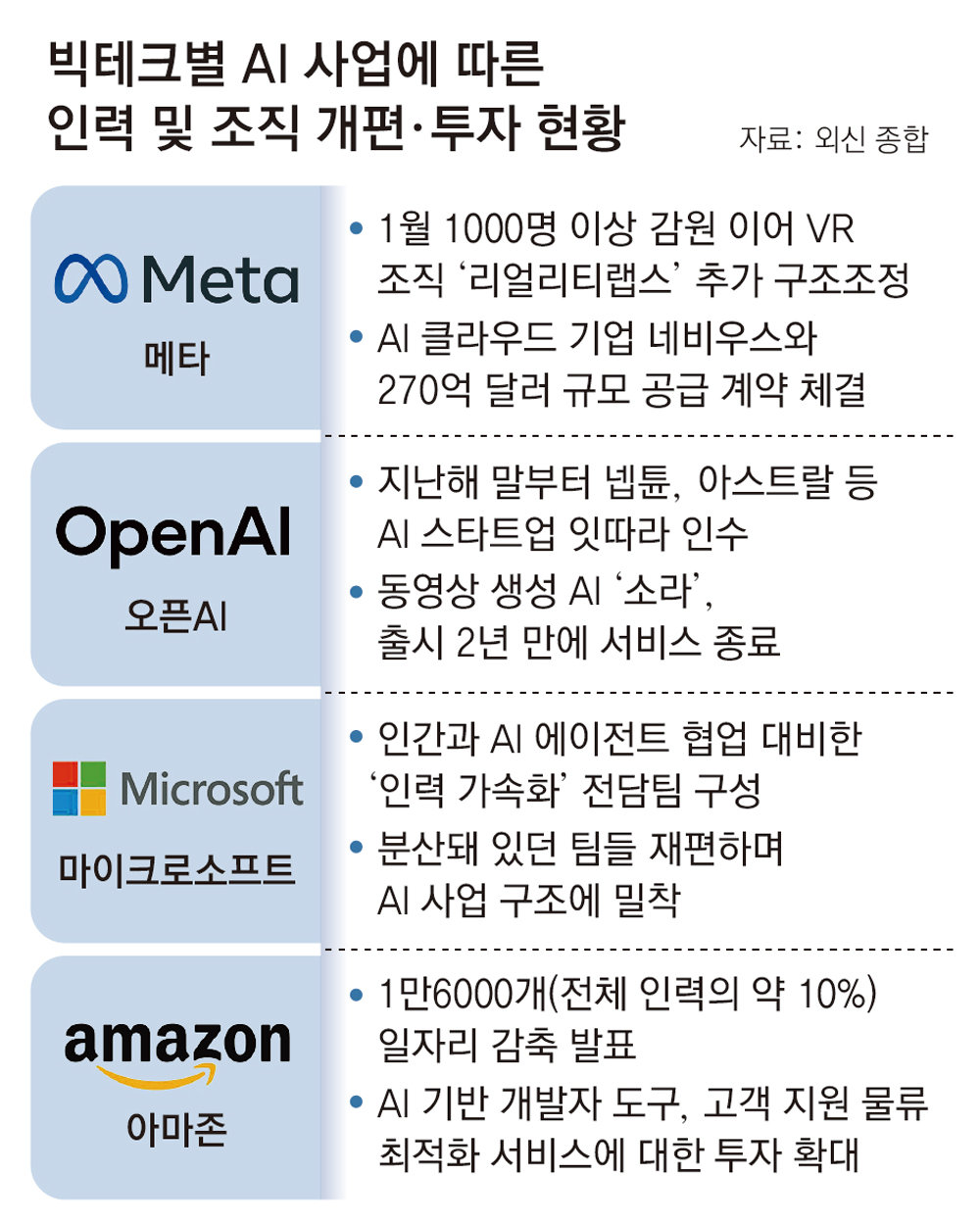
According to Bloomberg on the 25th (local time), Meta has laid off hundreds of employees, mainly at Reality Labs, which was responsible for developing virtual reality (VR) devices. This is an additional measure following cuts of more than 1,000 employees at Reality Labs in January this year. A Meta spokesperson stated, “Meta teams regularly implement reorganizations and changes to create the optimal environment for achieving their goals,” adding, “Employees affected are seeking other opportunities.”
After changing its corporate name from “Facebook” to “Meta” in 2021 and fully entering the metaverse business, Meta recorded more than USD 70 billion (about KRW 100 trillion) in operating losses over five years. In the end, at the end of last year it decided to withdraw from most of this business, except for some areas such as smart glasses. Instead, Meta has been actively building AI infrastructure, signing successive AI chip purchase and leasing contracts with Nvidia, AMD, and Google. It is poised to make large‑scale investments, having signaled related capital expenditures of up to USD 135 billion (about KRW 200 trillion) this year. Industry observers interpret the latest job cuts as an effort to offset these astronomical investment costs.
Despite large‑scale layoffs, the company is aggressively recruiting AI core talent. Recently, Meta hired Hugo Barra, David Singleton, and Nicholas Zitko, co‑founders of AI startup Dreamer, assigning them to its core organization, “Meta Superintelligence Labs (MSL).” Hugo Barra, formerly Meta’s vice president of VR, has returned to the company after five years to work on AI agent development. An industry insider said, “Meta’s sense of crisis over its failure to narrow the gap with AI leaders such as OpenAI, Anthropic, and Google appears to underlie these hires.”
● Focusing on ‘profitable AI’ while raising capital
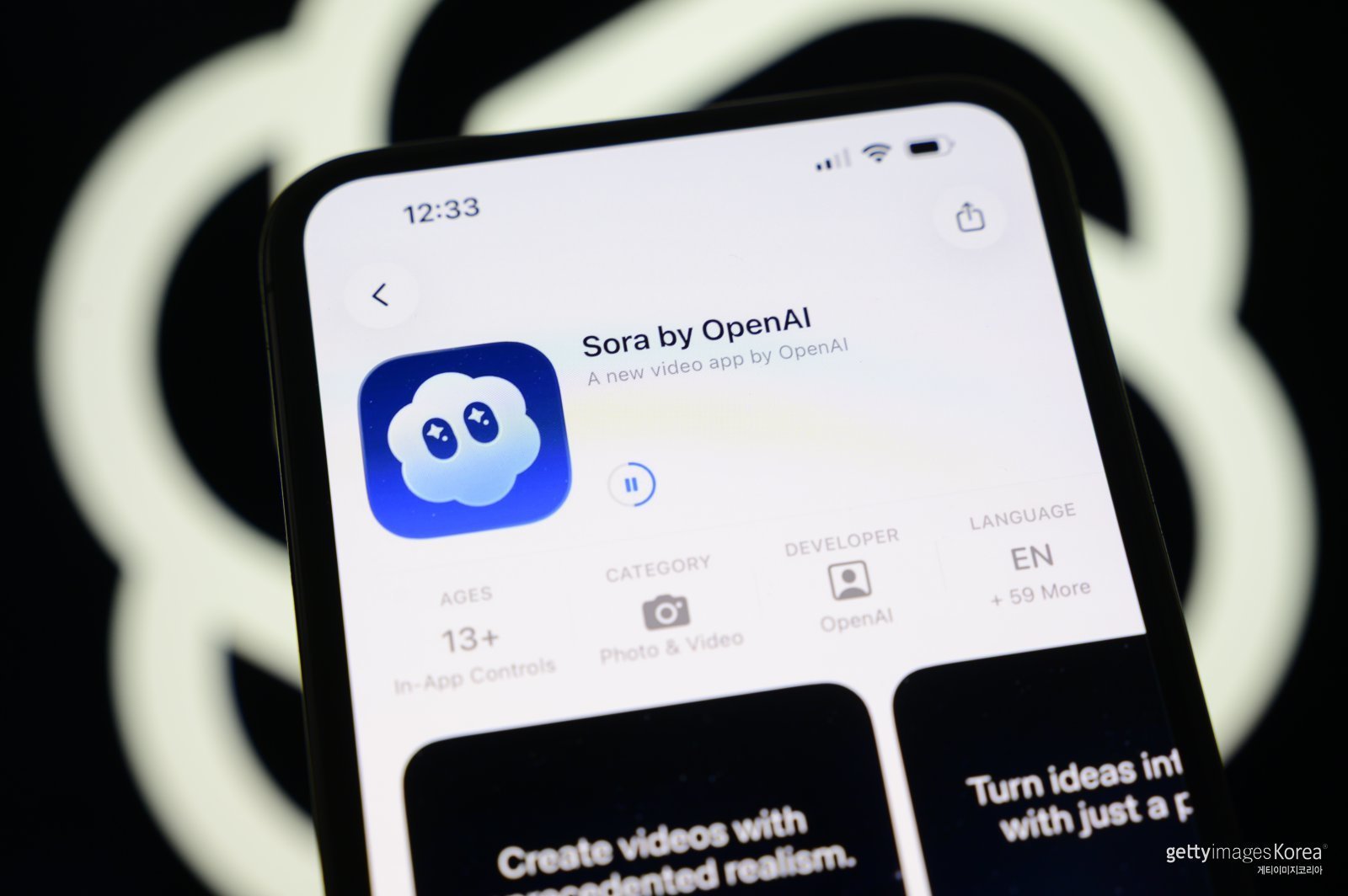
OpenAI’s video‑generation AI “Sora” app is displayed on a smartphone screen. Getty Images
OpenAI, which is preparing for an initial public offering (IPO) this year, is in the midst of raising capital. According to Bloomberg and others the same day, OpenAI is expected to soon sign agreements to raise about USD 10 billion (about KRW 15 trillion) from venture investors and is likely to secure a total of more than USD 120 billion (about KRW 180 trillion) in this round. OpenAI is using the funds raised to build a “business structure” capable of expanding revenue, for example by acquiring Astral, a startup that develops Python (programming language) tools for developers.
At the same time, it has moved decisively to trim “unprofitable” AI businesses. On the 24th (local time), OpenAI announced that it would shut down “Sora,” a text‑to‑video‑generation AI service launched in February 2024, two years after its release. The decision reflects the view that Sora requires high computing costs but generates limited profitability, and the company appears set to focus on enterprise AI development that can significantly boost revenue.
Analysts also point out that aggressive moves by other big tech firms such as Anthropic and Google contributed to the decision. Anthropic’s enterprise AI “Claude Opus” series has become highly popular among developers, narrowing OpenAI’s position in the business‑to‑business (B2B) market, while Google’s Gemini is rapidly increasing its presence.
MS and Amazon are concentrating on restructuring for efficiency. MS has completely revamped its HR organization to align with its AI business structure. It is also establishing a dedicated “workforce acceleration” team to handle workforce redeployment and retraining in preparation for collaboration between humans and AI agents.
Amazon is also pursuing aggressive restructuring, having announced at the beginning of the year that it would cut about 16,000 jobs worldwide. This follows layoffs of around 14,000 employees at the end of last year. The job cuts include staff in AWS (Amazon Web Services), retail, Prime Video, and HR departments. An Amazon representative said, “By presenting AI as a growth pillar, the company plans to expand investment in AI‑based developer tools, customer support, and logistics optimization services.”
ⓒ dongA.com. All rights reserved. Reproduction, redistribution, or use for AI training prohibited.
Popular News








 About Dong-A Ilbo