[Now the Innovation Finance War] 〈4〉 Boston, the ‘Bio Incubator’
VC that gave birth to Moderna, overseeing early-stage firms
Sharing and collaborating on cutting-edge equipment worth billions of dollars
Overcoming uncertainty to build a KRW 5 trillion fund… amplifying the clustering effect of startup investment finance
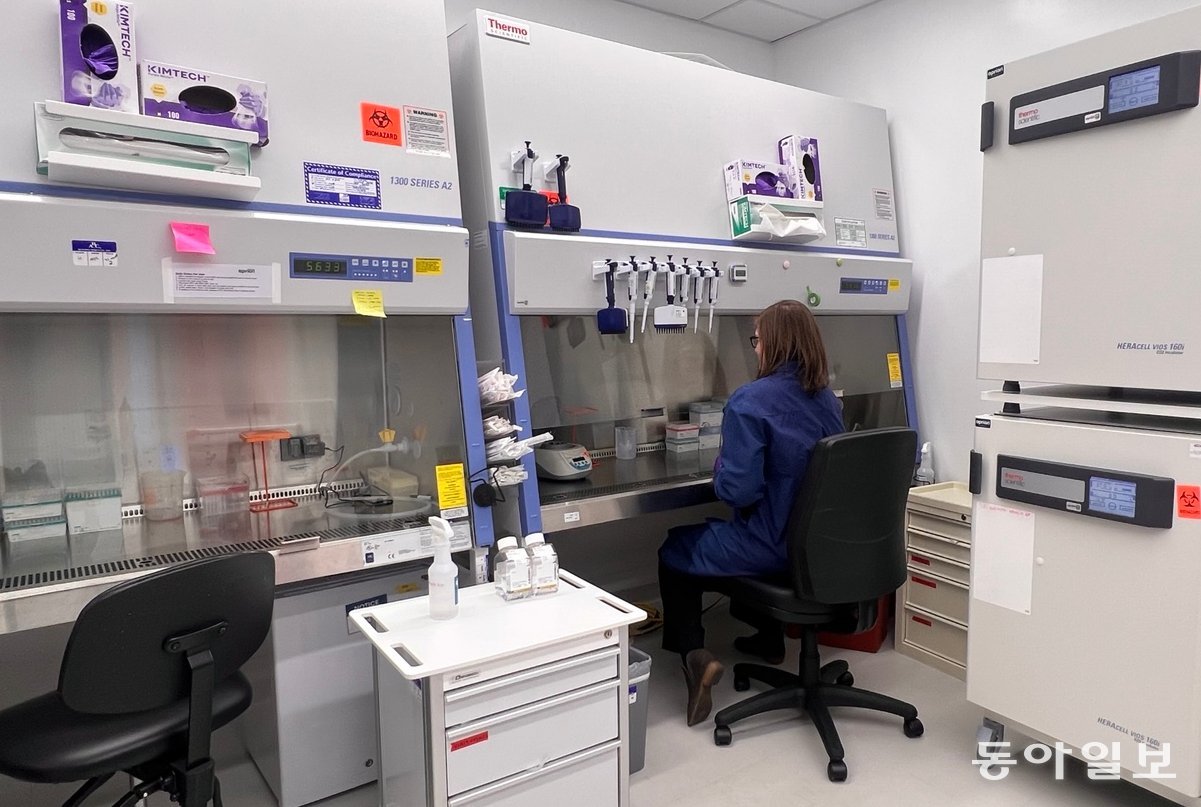
On December 11 last year, an employee conducts a virus experiment at the laboratory of Apriori Bio in Somerville, Massachusetts, United States. Here, ultra-high-priced experimental equipment that ordinary startups can hardly afford is shared, and experts gather for active idea discussions. Somerville = Correspondent Woo-Sun Lim imsun@donga.com
On December 11 last year (local time) in Somerville, Massachusetts, United States. Together with Kendall Square in Cambridge—nicknamed “Silicon Valley of the U.S. bio industry” and “the most innovative one square mile on Earth”—this area forms a biotechnology innovation belt and is home to Apriori Bio (hereafter Apriori).
Apriori is a biotech venture that aims to use artificial intelligence (AI) and machine learning to predict future viral mutations and develop effective vaccines accordingly. Flagship Pioneering (hereafter Flagship), a venture capital (VC) firm famous in the global biotech industry for nurturing Moderna, the developer of a COVID-19 vaccine, led the founding of the company.
Unexpectedly, in the building where Apriori is located, five other biotech venture companies founded by Flagship could be seen on the same floor. The space effectively serves as a large-scale incubator where Flagship gathers promising startups and helps them grow. Flagship, a provider of “innovation finance” that actively invests in cutting-edge startups, was amplifying startup synergies by clustering these seed-stage companies.
● A biotech startup complex built by a major VCThe companies were sharing one wide floor divided into separate sections. With no partition walls erected, the open space from the outside looked like one massive research lab belonging to a single company.
An Apriori representative met in the lab said, “Our company has about 20 employees, so we are exactly at a startup scale, but the resources we enjoy are at a level ordinary startups cannot access.” The representative added, “Because several Flagship-backed biotech ventures across different fields collaborate and share resources in one space, there is an abundance of specialized talent ranging from AI experts to computational biologists, data analysts, and experimental researchers, and we can use cutting-edge equipment worth several billion dollars, which is a huge advantage.”
The Flagship-founded venture research space visited that day was filled with advanced equipment capable of completing in a day or just a few hours research tasks that would take dozens of employees several days or even weeks—from cell culture and analysis to deep sequencing, a next-generation gene-reading technology. There was also equipment that automatically stores and dispenses dozens of viral samples like a vending machine.
The Apriori representative said, “Thanks to this level of investment and equipment, we can use that time to read better papers and ask more intellectual questions,” adding, “Through the investment and collaboration that take place within Flagship, we can work in the most innovative way possible at the forefront of science and technology.”
● VC participates not just in investment but in the founding processCraig Williams, CEO of Apriori and formerly of Flagship, who was met on site, explained, “All of this is possible because Flagship has its own unique venture investment process.” Unlike typical VCs that simply invest in promising ventures and earn returns, Flagship has its own “origination” process.
Every year, Flagship’s in-house dedicated organization derives around 100 “What if?” questions. About 200 in-house scientists then eliminate the questions that lack feasibility. At this stage, the key is “whether multiple innovation opportunities can emerge in different directions from a single technology.” Through this process, Flagship narrows down to three or four final questions with sufficient value to be turned into companies through investment.
CEO Williams said, “Flagship wants to invest in the ‘zone of uncertainty’ where nobody knows the answers and where true innovation can emerge,” adding, “But since risk must be reduced, this method of investing only in ideas that survive to the end and are validated is immensely helpful.”
Even after Flagship decides to invest, it does not immediately become a company. Initially, only a project number is assigned without a company name. CEO Williams said, “Apriori was initially just ‘FL (Flagship Lab) 77’,” noting, “The idea is not to cling too much to the notion of a company before the platform to answer the question is proven to work, but instead to freely explore new areas.”
As a result, biotech companies in which Flagship invests and whose founding it leads can move quickly and innovatively in their respective specialized fields. CEO Williams said, “Through partnerships with global pharmaceutical companies such as Pfizer, Novo Nordisk, and GSK, Flagship plays a kind of R&D engine role for big pharma,” and evaluated, “From an investor’s standpoint, the closer one gets to this kind of innovation ‘source,’ the greater the potential returns, which is why enthusiasm for Flagship’s investments is inevitably strong.”
● Flagship has supported the founding of 118 companies over 25 years
Flagship forms a global fund every three years to invest in biotech ventures. The most recent fund was KRW 36 billion in size (approximately KRW 5.2 trillion), and the previous fund amounted to KRW 33 billion. From Moderna to Apriori, this is how Flagship has led the founding of 118 companies over the past 25 years.
Andre Andonian, Asia-Pacific Chair and Strategic Advisor for Asia-Pacific at Flagship, stressed, “Flagship is not a VC but a company creator.” He said, “We generate ideas ourselves, nurture entrepreneurs, provide funding, and handle everything from operating to scaling companies under one roof,” adding, “Twenty-five percent of the lab space in Kendall Square is related to Flagship, and through this we have created 10,000 jobs.”
Chair Andonian said, “VCs and startups play a very large role in terms of innovation,” adding, “That is why we want to invest not in ‘pilots’ but in ‘astronauts’ who will go into uncharted territory.”
““A KRW 1,000 trillion market bigger than semiconductors… Korean startups must step into the big league”
Big Five hospital data and strong talent base
Boston heavyweight Flagship also explores Korean market
“If the semiconductor market is worth around KRW 400 trillion, the new drug market exceeds KRW 1,000 trillion. With an annual growth rate of 12%, it is impossible not to bet on bio.” (Lee Sung-hwan, Director, SV Investment)
Korean venture capitalists (VCs) met in Boston and Cambridge, the mecca of the U.S. biotech industry, unanimously said that more Korean VCs and biotech companies must jump into this market and expand overseas.
Yoon Dong-min, CEO of Solasta Ventures, who entered Boston in 2014 and this year marks his 13th year investing in local biotech ventures, said, “In biotech investment, it is crucial to be on the ground, sensing trends in real time, networking with key industry figures, and identifying proprietary development information,” adding, “The greatest advantage of this place, where hundreds of biotech ventures and the heads of R&D at global big pharma companies gather, is the sheer volume of data available for benchmarking.”
Director Lee said, “In Korea, the biggest problem is that if a biotech venture does not go public after initial funding, there is no way for it to be properly valued in the interim,” emphasizing, “In the United States, there are various exit opportunities through partnering with big pharma midway, selling licenses, or engaging in mergers and acquisitions (M&A), and in many cases, companies receive valuations four to five times higher than in Korea.”
Among Korean VCs, the number that have opened offices and made a full-fledged entry into Boston can be counted on one hand. Director Lee said, “This is because even by managing only policy funds from Korea or listing companies only on KOSDAQ, VCs can comfortably sustain themselves,” arguing, “Korean VCs and companies must increasingly step into larger markets, serve as a bridge between the Korean and U.S. industries, and create success stories to drive the development of the bio industry.”
Meanwhile, they noted, “Since two to three years ago, interest in the Korean biotech market has been growing among Boston VCs,” and assessed, “They find the Korean biotech industry highly attractive in many aspects, including its outstanding talent, the vast patient volumes and data at the Big Five hospitals that are hard to match anywhere else in the world, and the market’s capital strength.”
In fact, Flagship Pioneering, a leading U.S. biotech VC, opened a branch in Singapore two years ago and is now developing three country markets, including Korea and Japan. Flagship Asia-Pacific Chair Andre Andonian said, “Asia is both a source of innovation and the largest market,” adding, “There are so many opportunities that our biggest concern is where to prioritize our time and efforts.”
ⓒ dongA.com. All rights reserved. Reproduction, redistribution, or use for AI training prohibited.
Popular News








 About Dong-A Ilbo