[AI Robots Transforming Korean Manufacturing] 〈2〉 Samsung’s ‘AI Factory’ Experiment
Beyond automation, the entire plant becomes an ‘AI robot’… autonomously learning, designing and manufacturing products
Implementing ‘digital twins’ to build virtual factories
Changing shipbuilding and construction sites once crowded with workers… AI performs cutting and welding with zero error
Samsung Electronics’ semiconductor manufacturing and research complex, the “Hwaseong Campus” in Hwaseong, Gyeonggi Province, covers 1.58 million ㎡ (approximately 480,000 pyeong), a size comparable to KAIST’s Daedeok Campus (about 1.43 million ㎡). Although it appears quiet from the outside, a project to build an “AI factory” that will transform the global manufacturing paradigm is underway there. Beyond existing automated processes, the entire plant is being converted into an autonomous manufacturing infrastructure that learns, makes decisions and manufactures on its own like one giant AI robot. This is why the AI factory is described as the ultimate form of physical AI.
To this end, Samsung Electronics has invested KRW 1.5 trillion in the Hwaseong Campus to open the nation’s largest high-performance computing (HPC) center, which stores and processes semiconductor design and process data, and began full-scale operations last year. Industry observers interpreted the unusual move of building an 11-story computing center packed with servers within a semiconductor plant as a strategic step for the transition to an AI factory. Samsung Electronics has declared, in partnership with Nvidia, that it “will build the industry’s best-in-class semiconductor AI factory and change the global manufacturing paradigm.”
Samsung Electronics Chairman Lee Jae-yong visited the Hwaseong Campus in late December last year to closely inspect the status of the manufacturing automation system incorporating digital twin and robots, and called for the “restoration of fundamental technological competitiveness.”
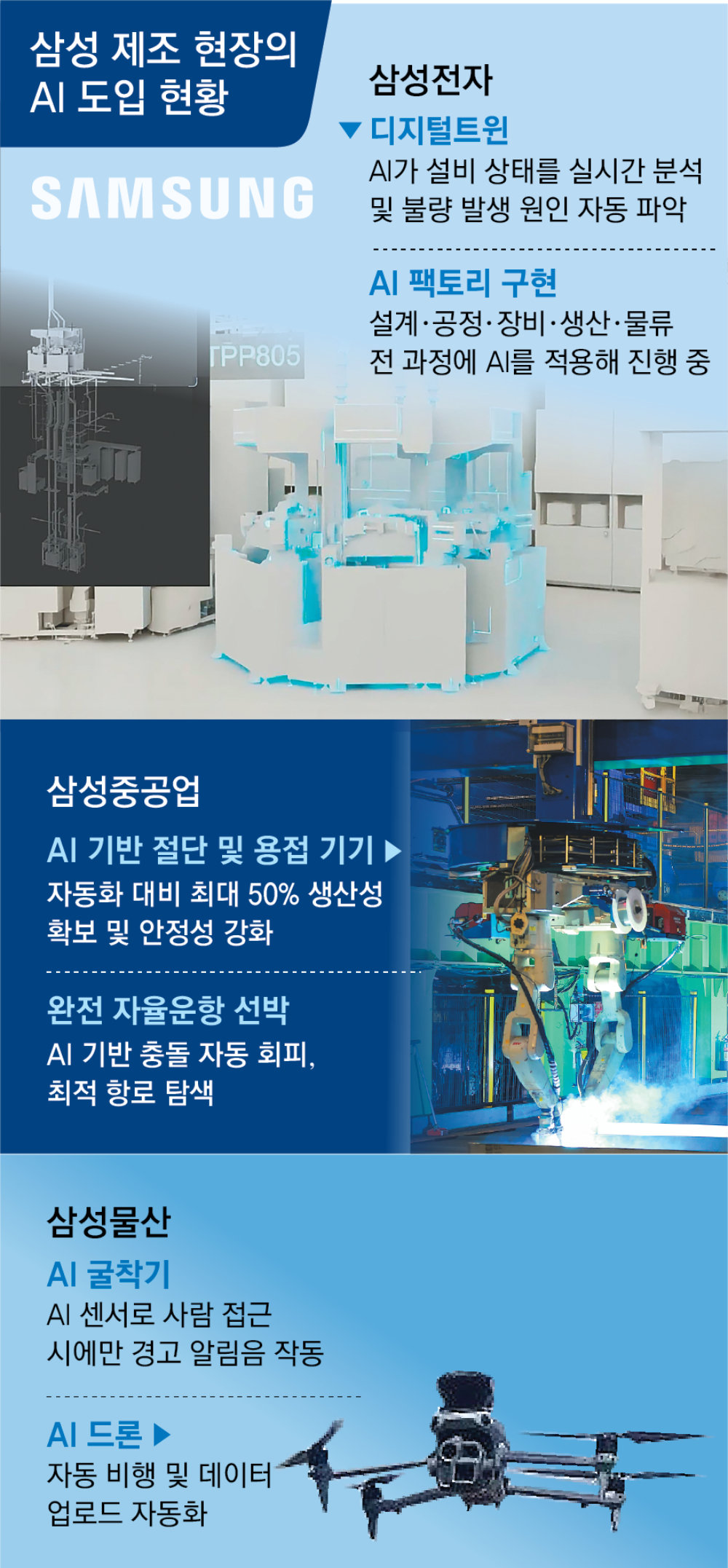
● Semiconductor process speed increased 20-fold with AI implementationThe AI factory is not a distant vision but already in progress. Samsung Electronics has introduced AI into semiconductor circuit design, achieving roughly a 20-fold increase in process speed compared with conventional methods. AI calculates billions of circuit patterns to identify the optimal design conditions. This reduces circuit distortion and significantly lowers defect rates.
This applies to optical proximity correction (OPC), a core step in semiconductor manufacturing. OPC is a correction process to implement fine circuits on a silicon wafer without distortion and is also called the “photo process” because it involves printing circuits like photographs. The vast amount of computation meant simulations took a long time, but this has changed completely with the introduction of AI.
Source: Respective companies
Digital twin technology, referred to as the “brain” of the AI factory, is also spreading. Samsung Electronics’ DS (Device Solutions, semiconductors) Division has even established a dedicated “Digital Twin Center.” Digital twin technology transfers an entire plant into a virtual simulation environment to validate and apply optimal operating solutions to the field. It is expected to improve yields in the highly demanding semiconductor process, where even a single misstep among hundreds of steps can cause defects, and Taiwan’s TSMC is already accelerating deployment in this area. For the realization of AI factories including digital twins, Samsung Electronics is also reviewing a plan to deploy 50,000 graphics processing units (GPUs) supplied by Nvidia.
A Samsung Electronics official said, “Once the AI factory is fully realized, the industrial landscape will change so dramatically that it will be incomparable with what it is today,” adding, “Beyond reducing defect rates and improving process efficiency, once AI is fully involved in product design, completely new products that have never existed before could emerge.”
● AI-driven innovation also underway at labor-intensive shipyards and construction sitesAI is also driving productivity innovation at traditionally labor-intensive shipbuilding and construction sites.
Samsung Heavy Industries’ Geoje Shipyard, once crowded with workers, now looks as quiet as a large logistics warehouse on the outskirts of a city. This is because AI-based automated facilities have taken over a significant portion of dangerous and repetitive tasks.
In the past, workers had to directly enter job details into cutting machines, wait until the steel plate arrived, and then press the button. Now, “AI cutters” recognize the code on steel plates, cut them automatically with no errors, and carry out subsequent steps in sequence. The welding process has also changed. While some areas are still handled by humans, in processes where AI is applied, “AI welders” independently determine welding paths and conditions and complete the work.
Samsung Heavy Industries is also accelerating development of fully autonomous ships based on AI with a target of 2030. Through its test vessel “SHIFT-AUTONOMY (SHIFT-AUTO),” the company is validating technologies such as automatic collision avoidance, optimal route planning that takes typhoons and wave heights into account, and remote control using low Earth orbit satellite communications, and has already completed more than 10,000 km of autonomous navigation.
Park Jeong-seo, Head of ADX at Samsung Heavy Industries (Senior Vice President), said, “AI adoption has not only improved productivity but, more importantly, the know-how of skilled workers is being accumulated as data and becoming one of the company’s assets.”
Changes have also begun at construction sites. NCSoft’s RDI Center in Pangyo, currently being built by Samsung C&T, is a pilot site that aggregates smart construction technologies. Excavators fitted with AI sensors distinguish between people, objects and structures, and sound alarms only when a person is detected, significantly reducing false alarms. Drones used for exterior imaging are also drawing attention. These drones are fully automated, flying on predetermined schedules and transmitting data. Samsung C&T plans to assign similar AI robots to interior imaging in the future.
In addition, Samsung C&T, together with Amazon Web Services (AWS), is developing three types of AI agents—“AI Bid Proposal Reviewer,” “AI Contract Manager” and “AI Project Expert”—which will be deployed to sites this year.
A Samsung C&T official said, “The scale of change driven by AI adoption will be much greater than it is now.”
Samsung moves to become an “AI company”… 3,000 staff assigned to Semiconductor AI Center
Digital Twin Center established in DS Division
“AI Innovation Taskforce” set up in each DX business unit
Samsung Electronics is expanding and restructuring AI-related organizations across all its business areas, including semiconductors, smartphones and home appliances, as it works to reshape itself into an “AI-driven company.” In particular, it is positioning “digital twin” technology—which replicates physical spaces such as factories in virtual environments—as a core pillar of its AI transition and is significantly expanding the organization responsible for it.
The Device Solutions (DS) Division, which oversees Samsung Electronics’ semiconductor business, established a “Digital Twin Center” in its regular year-end reshuffle last year to implement the “AI factory,” and formed four teams under the center: the Digital Twin Office, the A-Fab Technology Team, the A-Infrastructure Technology Team and the DS Equipment Academy. These teams are responsible for developing and standardizing equipment and infrastructure for factory automation.
The DS Division has also assigned more than 3,000 staff to its AI Center, which acts as the control tower for AI transformation, including the AI factory. This represents more than 4% of the DS Division’s total workforce of about 70,000. It underscores the scale of human and material resources being invested in AI transition.
The Device eXperience (DX) Division, which is responsible for smartphones and home appliances, is likewise accelerating its AI transition. The DX Division created an “AI Productivity Innovation Group” last year and set up “AI Productivity Innovation Offices” within each business unit. It has also newly organized an execution-focused unit, the “InnoX Lab,” to drive key AI transformation projects intensively.
The importance of AI transition within Samsung Electronics’ overall management is growing steadily. AI was reportedly one of the core agenda items at the Global Strategy Meeting held late last year. An executive at Samsung Electronics said, “There were strong directives for each division regarding AI transition at the Global Strategy Meeting,” adding, “Since most of the products to be launched this year are directly connected to AI, there is a sense that it is impossible to discuss management without AI.”
Jeon Young-hyun, Head of the DS Division (Vice Chairman), and Roh Tae-moon, Head of the DX Division (President), both emphasized AI-centric management in their New Year’s addresses, saying, “Let us lead the AI era through AI transition.” Vice Chairman Jeon said, “We will lead the AI era together with our customers based on our semiconductor one-stop solution capabilities,” while President Roh said, “We will innovate not only how we work but also how we think by leveraging AI, thereby increasing work speed and productivity.”
Digital Twin
A core technology of AI factories that transfers entire manufacturing sites into virtual space. All variables can be tested in advance in the virtual world and then applied to the actual plant.
ⓒ dongA.com. All rights reserved. Reproduction, redistribution, or use for AI training prohibited.
Popular News







 About Dong-A Ilbo