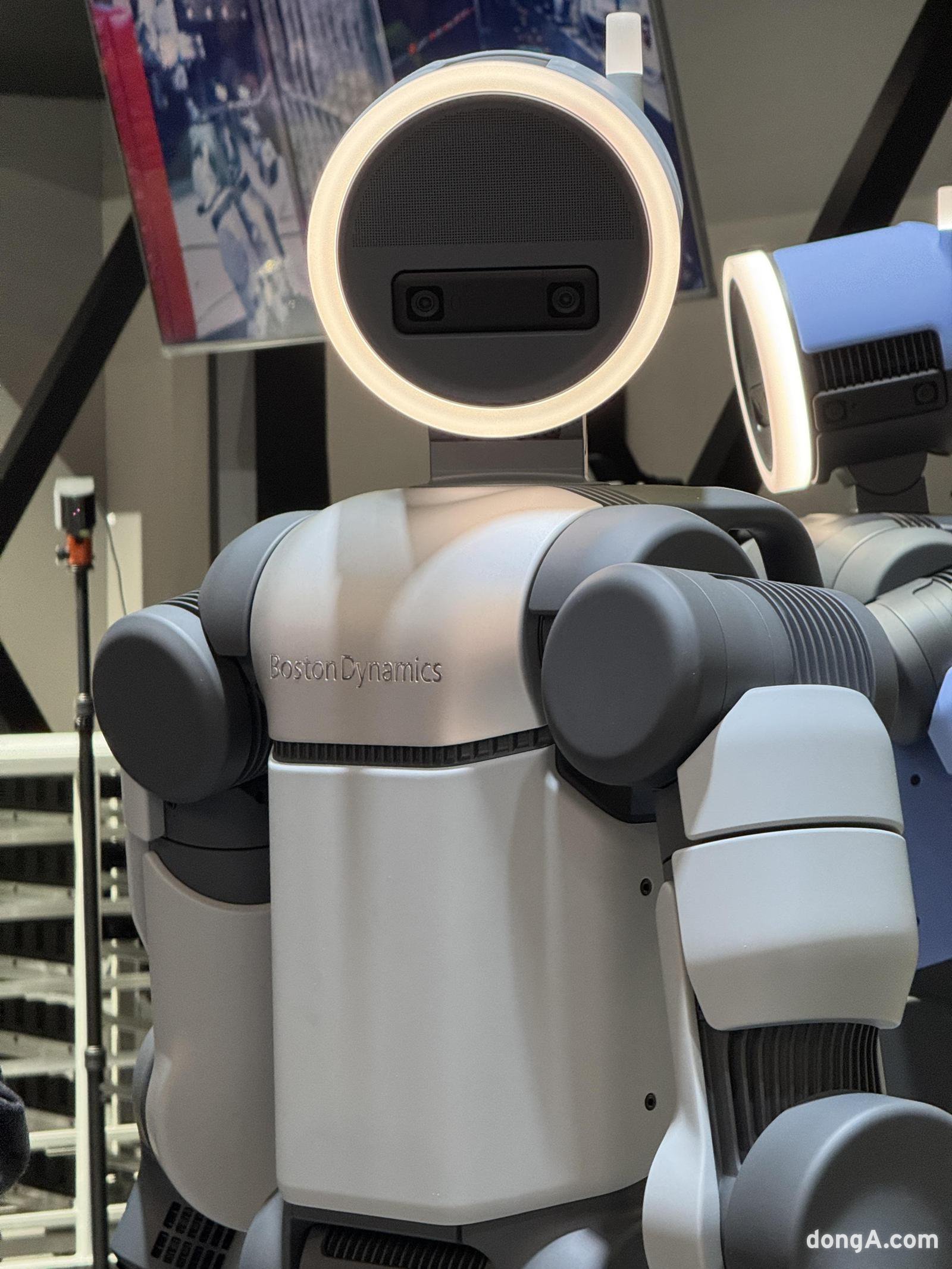
Boston Dynamics humanoid robot Atlas. Photo by Reporter Jeong Jin-soo
Humanoid robots are finally beginning to live up to their name. In the early days, simply moving their arms and legs was astonishing, but playing the piano or dancing in time with music is no longer an unfamiliar sight.
Today’s humanoid robots behave in a way that is quite similar to humans. They can handle simple tasks such as folding laundry or sorting objects, and have now advanced to a level where they recognize their surroundings and move autonomously based on their own judgments.
CES, which officially opened on the 6th (local time), served as a stage to gauge the current state of highly advanced robots equipped with so‑called “physical artificial intelligence (AI)” technologies. The robots exhibited this year no longer appeared as mere demonstration models for display, but instead as devices that directly assist everyday life and labor.
Physical AI is a core technology that completes humanoid robots. It enables AI, through robots or autonomous driving systems, to perceive the environment in the real physical world via sensors, make independent decisions, and link those decisions to actions.
Hyundai Motor Group, returning to CES after two years, made clear its intention to lead in the field of physical AI. For its comeback, it put forward Atlas, a humanoid robot under active development by its U.S. subsidiary Boston Dynamics, as the centerpiece to seize the initiative.
Atlas, which has the physique of an adult at 170 cm, performed a variety of movements during a short five‑minute demonstration. It rotated its joints 360 degrees and mimicked grasping objects, showing motions similar to human behavior. The company explained that tactile sensors are embedded in its hands so it can detect objects. Its 56 degrees of freedom help the robot rotate its body. In addition, it can lift up to 50 kg and extend its arms up to a height of 2.3 m. It also possesses learning capabilities that enable it to carry out a range of tasks from material handling to precision assembly. Atlas is scheduled to be deployed in earnest at production hubs, including Hyundai Motor Group Metaplant America (HMGMA), from 2028.
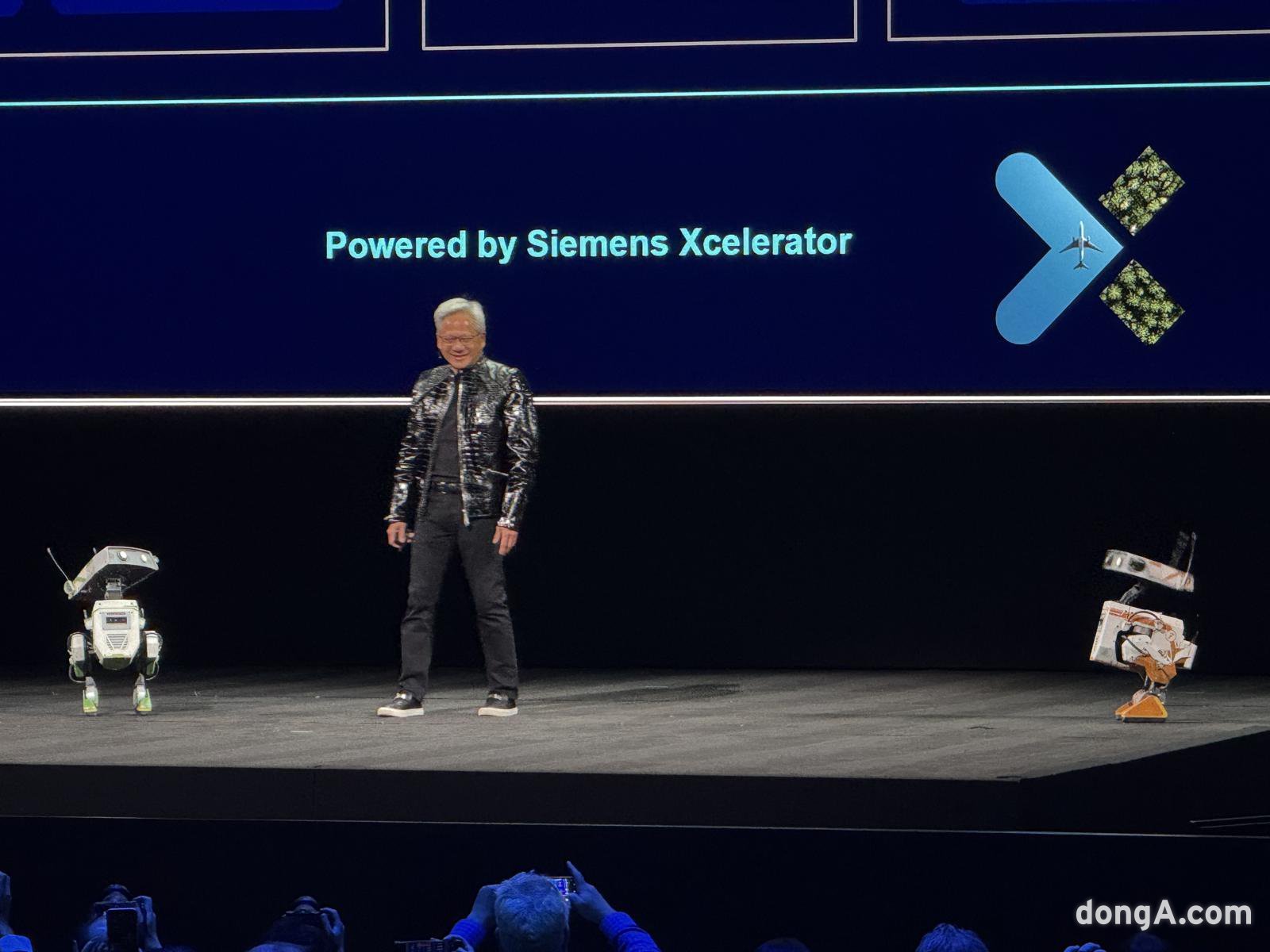
NVIDIA CEO Jensen Huang introduces the Star Wars bipedal robot bdx droid at the CES 2026 media preview event held at the Fontainebleau hotel on the 5th (local time). Photo by Reporter Jeong Jin-soo??
At this year’s CES, NVIDIA, which based itself at the Fontainebleau hotel in Las Vegas, brought two units of the bipedal robot “bdx droid” from the Star Wars films to its media event. When NVIDIA CEO Jensen Huang shouted “Jump” at the venue, the two robots immediately executed the command, drawing gasps from the audience. Jensen Huang said, “To implement AI that interacts with the real world, learning and inference, as well as simulation, must be combined,” adding, “To this end, NVIDIA is utilizing the digital twin platform Omniverse and the foundational model Cosmos, which understands the world.” Cosmos, which NVIDIA developed to harness physical AI, is designed to faithfully reflect the laws of physics in the real world. As a result, by pre‑experiencing countless scenarios in which it moves, collides, and reacts as in reality, it enables robots to behave naturally in the real world.
LG Electronics also unveiled a robot already usable in daily life, “Cloid.” Cloid demonstrated fetching the user’s desired milk from a refrigerator and placing it on a table, as well as preheating an oven and carrying out baking. It also performed folding towels taken from a basket. An LG Electronics representative said, “Through Cloid, we will materialize our vision of ‘acting AI’ that goes beyond a simple AI assistant to autonomously orchestrate home appliances, recognize situations, and make everyday life more efficient,” adding, “In addition to Cloid, which is specialized for homes, we plan to develop new solutions so that such experiences can be connected across various spaces, including vehicles, workplaces, and stores.”
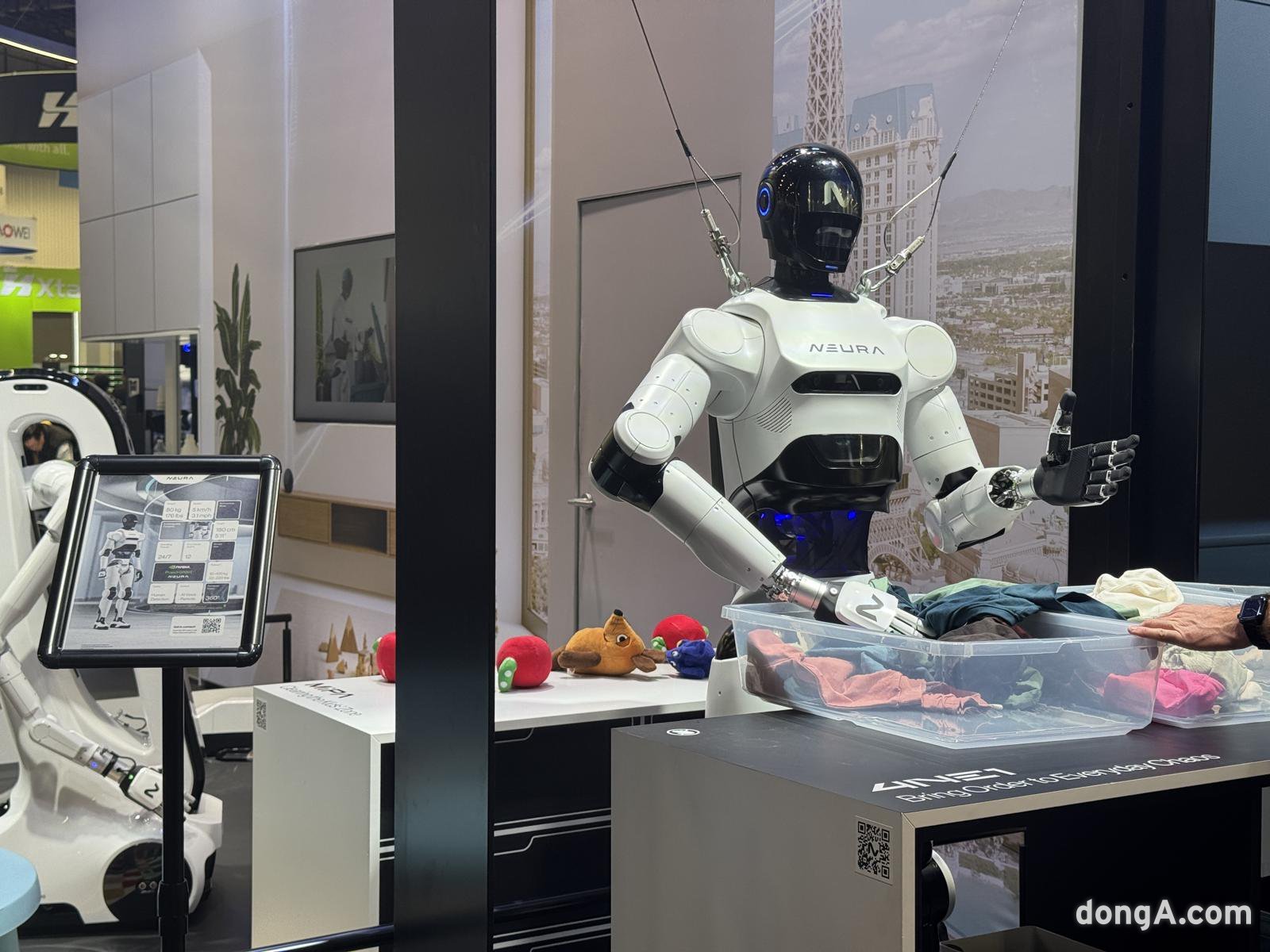
NEURA Robotics’ third-generation humanoid robot 4NE1 organizing clothes. Photo by Reporter Jeong Jin-soo
German robotics company NEURA Robotics unveiled its third‑generation humanoid robot “4NE1 (pronounced Four‑Knee)” at CES 2026. The newly introduced 4NE1 is a platform newly designed in collaboration with Porsche design studio “Studio F.A. Porsche.” It was developed with the goal of becoming a general‑purpose humanoid that spans both industrial sites and home environments.
At the exhibition, NEURA Robotics demonstrated 4NE1 performing both industrial tasks and household assistance, emphasizing that it is a humanoid that can be used in environments where it shares space with humans. The centerpiece of this demonstration is its robot operating system “Nurarverse.” Nurarverse is an operating system designed to allow robots to share learned skills and task know‑how with the entire robot fleet in real time, enabling simultaneous advancement of multiple robots. Technically, the third‑generation 4NE1 uses high‑torque joints and can lift up to 100 kg. To prevent collisions, it is equipped with patented artificial skin that detects proximity in its surroundings. It is also powered by NVIDIA’s humanoid‑dedicated AI platform “Isaac GR00T.”
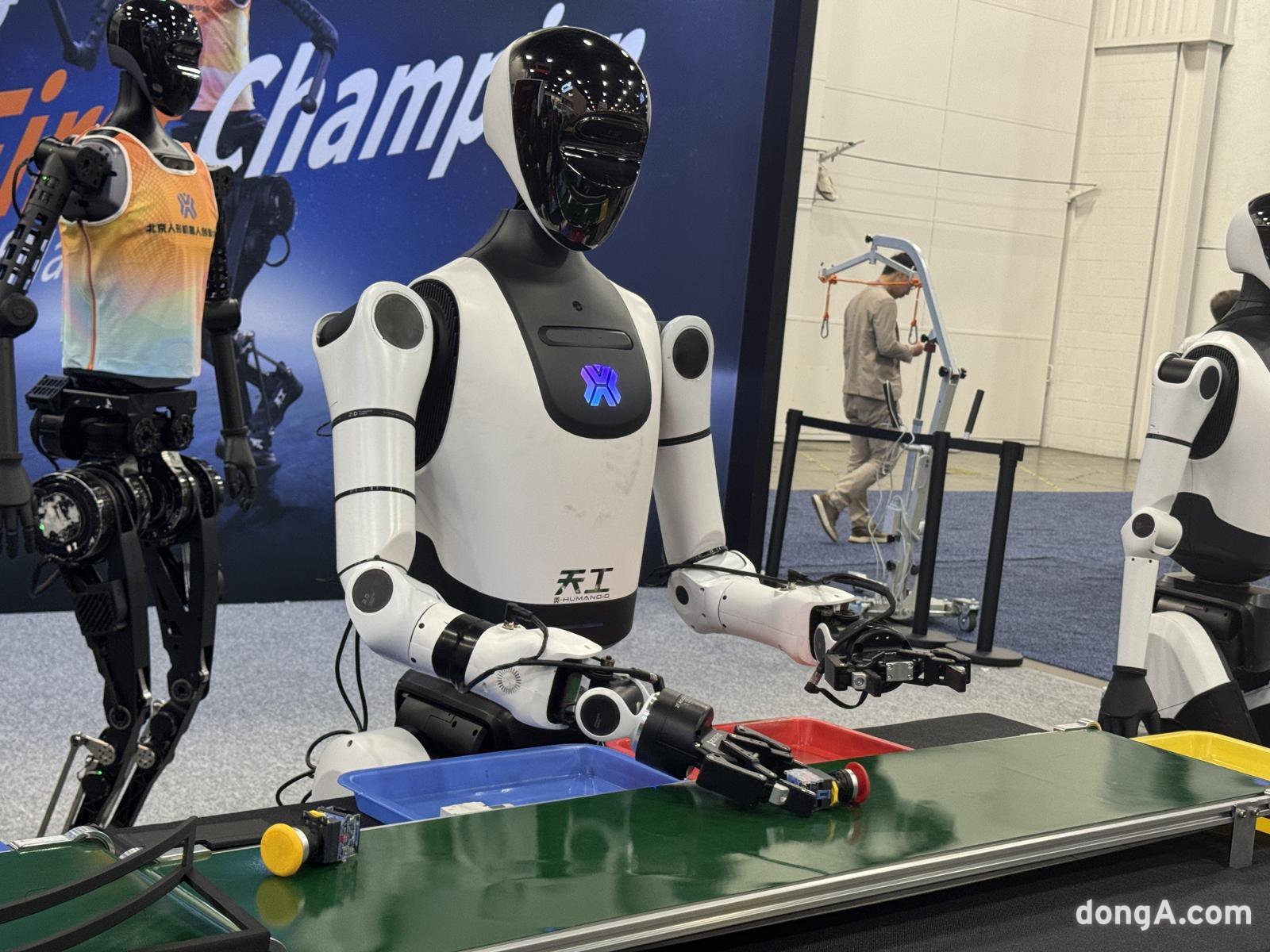
An X-Humanoid robot sorting parts. Photo by Reporter Jeong Jin-soo
In addition, X-Humanoid, which is backed by the Chinese government, unveiled six types of humanoid robots. At its booth in the Central Hall of the Las Vegas Convention Center, one robot was performing martial arts movements, while another beside it was sorting parts by color. Chinese company DYNA, participating at CES for the first time, also showcased its technological capabilities by demonstrating a robot that organizes T‑shirts and towels.?
ⓒ dongA.com. All rights reserved. Reproduction, redistribution, or use for AI training prohibited.
Popular News










 About Dong-A Ilbo