[CES 2026] New foldable phones to adopt in the second half of the year LG unveils size‑adjustable OLED for vehicles Humanoid‑targeted display also revealed
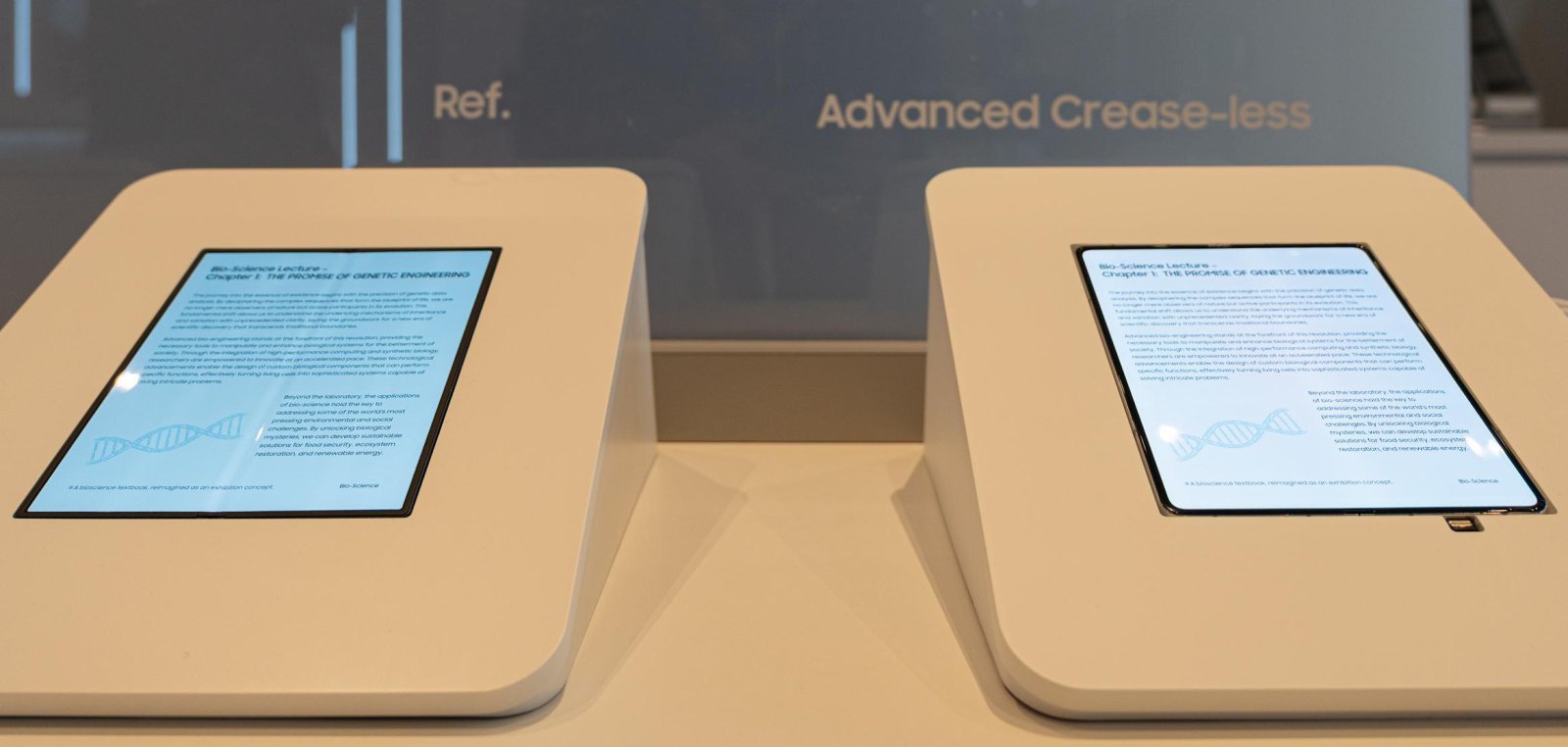
Samsung Display’s “crease-free” foldable organic light-emitting diode (OLED) panel (right), which reduces screen creasing at the fold by minimizing wrinkles, exhibited at the Wynn Hotel in Las Vegas, USA. Provided by Samsung Display
Samsung Display has unveiled a panel that reduces the screen crease in the fold area, regarded as a key challenge for foldable phones, by 20% compared with the previous model. LG Display showcased an in-vehicle slidable organic light-emitting diode (OLED) that can expand its screen size up to 33 inches depending on use conditions.
On 5 January (local time), one day before the opening of CES 2026, the world’s largest consumer electronics and information technology (IT) exhibition, Samsung Display exhibited its “crease-free” foldable OLED panel with reduced screen wrinkling at the Wynn Hotel in Las Vegas, USA. Hands-on examination at the site showed that the crease on this panel was visibly shallower and flatter than that of the previous generation foldable panel. As the crease of a foldable panel becomes shallower, the refracted area decreases, improving consumers’ visual satisfaction. It also has the advantage of reducing the sensation of fingers catching or slipping when using the product.
Durability has also been improved. Even when a robotic arm shot a basketball at the panel, the panel remained intact. In an impact test dropping a steel ball from a height of about 30 cm, a competing foldable panel was damaged with a white line appearing after a single drop test, whereas the Samsung Display product remained unchanged even after multiple drops. This display is scheduled to be used in new foldable phone models to be released in the second half of this year.
Samsung Display also introduced an “artificial intelligence (AI) OLED Bot” fitted with a 13.4-inch OLED at the face position. A “teaching assistant robot” equipped with an OLED face can move around and provide students in a classroom with lecture information and other details. The necklace-type “AI OLED Pendant” offered a glimpse of a future-type AI device that could replace smartphones. It is a necklace form factor using a 1.4-inch circular OLED, making it easy to carry and operate by voice, while also enabling intuitive operation and information checking via the display.
On the same day, LG Display presented AI-friendly displays under the theme “AI-optimized displays, OLED for everyone.” New OLED products from LG Display were exhibited at a large OLED exhibition space set up at the Conrad Hotel in Las Vegas.
That day, Jeong Cheol-dong, CEO of LG Display, met with reporters at the Las Vegas Convention Center (LVCC) and said, “In the AI era, OLED will become the most effective display medium,” adding, “LG Display has been preparing in line with the speed at which robots are advancing.”
LG Display plans to unveil plastic (P)-OLED for humanoid robots at CES 2026. Thanks to its high flexibility, P-OLED is advantageous when displays need to be embedded in various parts of a robot’s body.
Las Vegas=Lee Min-a gijA omg@donga.com;Las Vegas=Park Jong-min gijA blick@donga.com
AI-translated with ChatGPT. Provided as is; original Korean text prevails.
ⓒ dongA.com. All rights reserved. Reproduction, redistribution, or use for AI training prohibited.








 About Dong-A Ilbo